
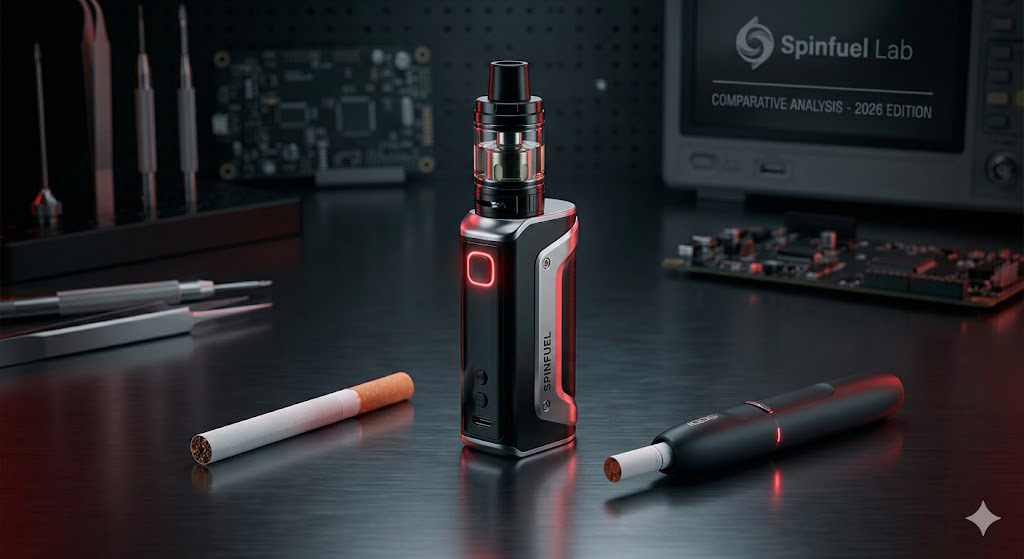
A Comprehensive Guide to Nicotine Delivery:
Smoking, Vaping, and Heated Tobacco Compared
Wellness Report • Spinfuel Staff
Navigating the world of nicotine delivery has never been more complex — or more consequential. Where once there was essentially one option (the cigarette, with all its well-documented costs), there are now three meaningfully distinct categories: combustible tobacco, electronic vaping devices, and heated tobacco products. Each works differently at the physiological level, each carries a distinct risk profile, and each suits different habits, budgets, and goals.
This guide is written for adults who are already using nicotine in some form and want a clear-eyed, evidence-informed comparison of their options. We are not here to moralize — we are here to inform. Whether you are a long-term smoker considering a transition, a vaper curious about heated alternatives, or simply someone who wants to understand the landscape, what follows is the most straightforward breakdown we can offer.
One thing to establish upfront: nicotine itself, while addictive, is not the primary driver of the health harms associated with smoking. The danger lies overwhelmingly in combustion — in the thousands of toxic compounds produced when tobacco is burned. That single fact is the axis around which all meaningful comparisons between these delivery methods rotate.
1. What Are Nicotine Delivery Systems?
A nicotine delivery system is, at its most basic, any mechanism that transfers nicotine from a product into the human body. Nicotine is a naturally occurring alkaloid found primarily in the tobacco plant. It binds to nicotinic acetylcholine receptors in the brain, triggering the release of dopamine and producing the stimulant and relaxant effects that drive its habitual use.
What varies enormously between delivery methods is not the nicotine itself — it is everything that accompanies it. Combustible cigarettes deliver nicotine alongside more than 7,000 chemicals in cigarette smoke, at least 69 of which are confirmed carcinogens. Vaping devices deliver nicotine in an aerosol produced without burning tobacco; the aerosol can still contain harmful substances. Heated tobacco products occupy a middle space, involving real tobacco but processed at temperatures below combustion.
Understanding which delivery method you are using — and what comes with the nicotine in that method — is the foundation of any informed decision about your own habits.
2. Smoking — The Oldest Method, The Highest Cost
How It Works
When a cigarette is lit, tobacco combusts at temperatures approaching 900°C. This combustion produces smoke — an aerosol of gas and fine particles containing nicotine, tar, carbon monoxide, formaldehyde, benzene, hydrogen cyanide, and hundreds of other compounds. Nicotine is absorbed rapidly through the lung tissue and reaches the brain within about ten seconds of inhalation, producing its characteristic effect almost immediately.
This rapid delivery is one reason cigarettes are so effective at creating dependence. The speed of nicotine absorption reinforces the behavioral association between the act of smoking and the neurochemical reward. The faster the hit, the stronger the conditioning.
The Health Picture
The evidence on smoking is unambiguous and has been for decades. Cigarette smoking is the leading cause of preventable death in the United States, responsible for more than 480,000 deaths annually according to the CDC. It is causally linked to at least twelve different cancers, chronic obstructive pulmonary disease (COPD), heart disease, stroke, and a range of other serious conditions. Secondhand smoke is also classified as a known human carcinogen, with documented harms to non-smokers including children.
The mechanism is not mysterious. The thousands of toxic byproducts of combustion cause persistent inflammation, cellular damage, and genetic mutation over years of exposure. There is no safe level of cigarette smoke inhalation. Every cigarette contributes to cumulative harm.
Worth Knowing
Quitting smoking at any age produces measurable health benefits. According to the CDC, within 20 minutes of the last cigarette, heart rate and blood pressure begin to drop. Within a year, excess risk of coronary heart disease is half that of a continuing smoker.
Practical Considerations
Cigarettes remain the most widely available and, on a per-unit basis, the least expensive nicotine delivery option at the point of purchase. However, the aggregate cost — accounting for volume of use, healthcare costs, and the demonstrated economic impact of smoking-related illness — is substantially higher than it appears. For those who have smoked for years, the financial and health calculus of continuing versus transitioning is rarely in favor of staying the course.
3. Vaping — The Evidence-Backed Alternative
How It Works
Electronic cigarettes heat an e-liquid into an aerosol that users inhale. The liquid commonly contains propylene glycol, vegetable glycerin, nicotine, and flavorings. An ingredient’s use in food does not establish that it is safe to inhale. Vaping avoids burning tobacco, but its aerosol can still contain harmful substances. The nicotine is absorbed through lung tissue in a similar fashion to smoking, though the speed and efficiency of delivery can vary depending on the device type and nicotine formulation.
The hardware landscape ranges from simple disposable devices and pod systems to sophisticated rebuildable atomizers and regulated mods. Each tier of the market offers different trade-offs between convenience, performance, cost, and customization. For readers new to the category, our guide for new vapers covers the full spectrum from starter kits to advanced setups.
The Health Picture
For adults who smoke, switching completely to nicotine vaping can reduce exposure to many toxins produced by burning cigarettes. The NHS describes vaping as less harmful than smoking, while emphasizing that it is not risk-free and that long-term effects remain uncertain. A 2015 UK estimate put the difference at around 95%, but that figure should not be treated as a precise lifetime-risk calculation for every current product. The strongest practical distinction is between fully replacing cigarettes and continuing to smoke alongside vaping.
The key qualifier is completely. Dual use — continuing to smoke while also vaping — delivers the harms of both without fully capturing the harm-reduction benefit of either. The evidence for vaping as a harm-reduction tool is strongest when the transition from cigarettes is total.
It is equally important to be honest about what we do not yet know. Vaping has existed as a mass-market product for roughly fifteen years. Long-term studies covering decades of exposure simply cannot exist yet. The health effects of e-cigarette use are an active area of research, and the picture will continue to develop. What the evidence currently does not support is the widespread public belief — documented in multiple surveys — that vaping is equally or more dangerous than smoking. That perception is not consistent with the available data.
“The evidence for vaping as a harm-reduction tool is strongest when the transition from cigarettes is total. Dual use delivers the harms of both without fully capturing the benefit of either.”
Practical Considerations
Vaping offers the widest range of hardware, nicotine strengths, and flavor options of any nicotine delivery method. Entry-level devices are inexpensive and require minimal knowledge to operate. Advanced setups — particularly those involving rebuildable atomizers and custom coil builds — offer a level of performance and customization that dedicated users find genuinely superior. Coil design and replacement frequency can affect ongoing hardware costs.
On budget: the real-world cost of vaping depends heavily on whether you treat it as a functional nicotine habit or an enthusiast pursuit. As the former, it is generally less expensive than cigarettes at equivalent nicotine consumption. As the latter — chasing the latest hardware, premium e-liquids, and exotic coil builds — costs scale accordingly. Knowing which camp you are in before you invest is worth a moment of honest reflection.
One frequently overlooked consideration for pet owners: vaping around pets carries specific risks, primarily through accidental e-liquid ingestion. Nicotine is acutely toxic to animals at relatively low doses. Proper storage of all e-liquid — child- and pet-proof containers, out of reach — is essential.
4. Heated Tobacco Products — The Middle Ground
How They Work
Heated tobacco products (HTPs) — also known as heat-not-burn devices — represent a different approach to the combustion problem. Rather than burning tobacco, these devices heat specially prepared tobacco sticks or inserts to temperatures typically between 250°C and 350°C. At these temperatures, nicotine and tobacco-derived compounds are released as an aerosol without triggering the full combustion chemistry that produces tar and many of the most harmful byproducts of cigarette smoke.
The most commercially prominent example is IQOS, manufactured by Philip Morris International. The FDA permits specific IQOS devices and tobacco sticks to make reduced-exposure claims when an adult smoker switches completely from cigarettes. That authorization is product-specific; it does not establish that IQOS is safe or that it reduces disease risk, and it does not apply to other heated products. The category has since expanded considerably, with various manufacturers producing devices that range from premium electronics to simpler, more accessible formats.
Some heated nicotine sticks use non-tobacco plant material in place of tobacco leaf; NEAFS is one commercial example. A tobacco-free label, the absence of ash, or lower levels of selected emissions does not by itself establish lower health risk. This article does not present product-specific independent evidence that would allow us to rank NEAFS against vaping, cigarettes, or other heated products. Readers should not read “tobacco-free” as “risk-free.”
The Health Picture
Heated tobacco emissions generally contain lower levels of some harmful ingredients than cigarette smoke, but they also contain harmful substances, including some found in cigarettes. The CDC says more research is needed to determine whether adults who switch completely reduce their risk of tobacco-related disease. FDA authorization for specified IQOS products concerns reduced exposure to certain chemicals, not a proven reduction in disease risk. We cannot infer a general percentage reduction in health harm from selected emission measurements or rank heated tobacco above vaping on the evidence presented here.
On Dual Use
Research consistently shows that a significant proportion of heated tobacco users continue to also smoke cigarettes. This dual use pattern negates much of the potential harm-reduction benefit. As with vaping, the case for switching is strongest — and the health argument most coherent — when the transition is complete rather than supplemental.
Practical Considerations
Heated tobacco products are generally more expensive than both cigarettes and vaping at equivalent nicotine consumption, primarily due to the proprietary nature of the consumable sticks and the required hardware investment. The experience is closer to smoking in terms of ritual and physical sensation — the draw, the throat hit, and the tobacco flavor profile — which makes them a more natural transition for long-term smokers who struggle with the behavioral shift vaping requires.
Availability varies considerably by country. In the United States, the category is growing but remains less accessible than in European and Asian markets where HTPs have captured significant market share.
5. Comparing the Methods — An Honest Look
With all three methods now examined in some depth, a direct comparison is useful. The table below is a simplified framework — none of these categories are monolithic, and individual products within each category vary substantially. But as a working orientation, it holds up.
| Factor | Smoking | Vaping | Heated Tobacco |
|---|---|---|---|
| Combustion | Yes (~900°C) | No | No (~350°C) |
| Contains Tobacco | Yes | No | Usually (not NEAFS) |
| Relative Harm | Severe, well-established harm | Less harmful than smoking for adults who switch completely; long-term effects still being studied | Lower exposure to some toxicants; reduction in disease risk not established |
| Flavor Variety | Limited | Extensive | Moderate |
| Relative Cost | Lower upfront | Moderate to variable | Higher |
| Long-Term Evidence | Extensive | Growing | Limited |
| Smoke / Odor | Yes, significant | Minimal, dissipates quickly | Minimal aerosol, some tobacco odor |
6. Choosing the Right Method for You
There is no universal answer here — the right nicotine delivery method is the one that best serves your particular situation. But there are some questions worth asking before making or changing a decision.
Are You Trying to Reduce Harm or Quit Entirely?
Harm reduction and quitting nicotine are different goals. Nicotine vaping can help some adults stop smoking, especially when cigarettes are fully replaced. Heated tobacco products have not been scientifically shown to help people quit smoking. Continuing to smoke alongside either product leaves cigarette-related harm in place.
What Does Your Lifestyle Actually Require?
Convenience, discretion, flavor preference, and social context all bear on this decision in ways that pure health metrics do not capture. A heated tobacco product may suit someone who wants the familiar ritual of a cigarette-sized stick and tobacco flavor without the smoke. Vaping may suit someone who appreciates the range of flavor options and the ability to precisely control nicotine concentration. Both are meaningfully different lifestyle propositions from smoking, and recognizing that difference honestly — rather than defaulting to whatever you already know — is the first step.
A Note on Medical Consultation
If you have a pre-existing respiratory condition, cardiovascular disease, or any other chronic health concern, the choice of nicotine delivery method is one to discuss with a healthcare provider. The general risk hierarchies outlined here apply at a population level. Individual circumstances can and do change the calculus.
What Is the True Cost of Each Option?
The upfront cost of cigarettes is lower than either vaping or heated tobacco, but this comparison is misleading on its own. Factor in volume of consumption, the compounding costs of health management for smoking-related conditions, and the well-documented quality-of-life impact of long-term smoking, and the economics shift considerably. Our breakdown of the real-world cost of vaping versus smoking shows that for most users who make a full transition, vaping produces meaningful financial savings within the first several months.
The Bottom Line
Combustible cigarettes have severe, well-established health risks. For adults who smoke, switching completely to nicotine vaping is generally less harmful than continuing to smoke, although vaping is not risk-free and its long-term effects are still being studied. Heated tobacco products can lower exposure to some chemicals compared with cigarettes, but that does not establish a reduction in disease risk. We cannot call a particular heated product the safest nicotine choice without stronger product-specific evidence. Readers considering a switch should focus on fully stopping cigarette smoking rather than adding another product alongside it.
Further Reading on Spinfuel
- → What Are Vape Coils and How Often Should You Replace Them?
- → What To Consider When You Want To Start Vaping
- → Habit or Hobby? The Real-World Costs of Vaping
- → Vaping & Pets: Tips on How to Keep Your Pets Safe
Published by Spinfuel Lab Research Division • NH – USA