
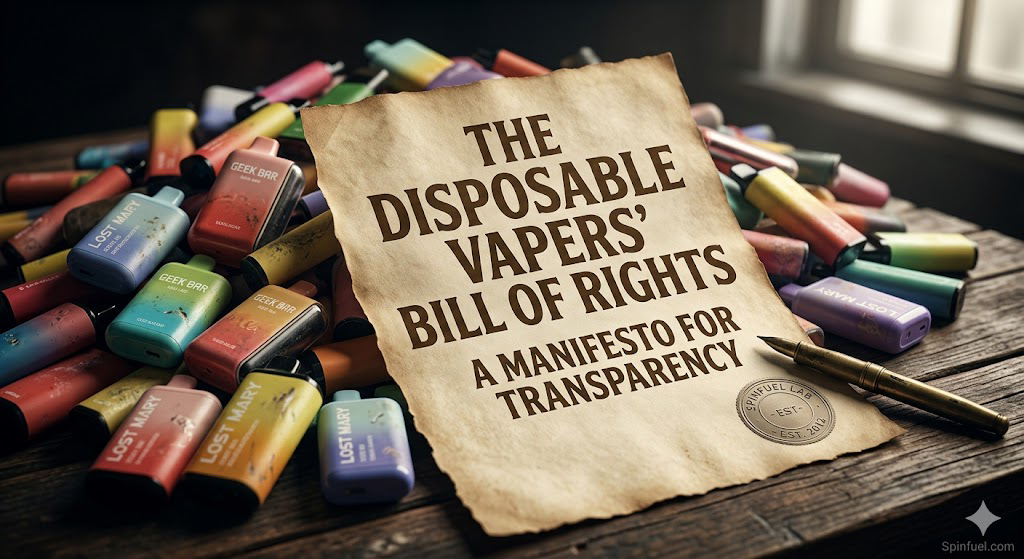
A Manifesto for Transparency in the World of Disposable Vapers
By John Manzione | Spinfuel Lab | April 7, 2026
I. The Wild West of 2026
Let me be honest with you — and honesty, as you’ll soon find out, is exactly what this piece is about.
I have been covering vaping for fifteen years. Fifteen years in the Spinfuel Lab means I’ve personally tested, reviewed, and dissected everything this industry has conjured up, from the earliest cig-a-likes — devices so primitive they made smokers laugh and vapers cry — to the sleek, screen-equipped “smart vapes” that clutter the shelves today. Back in 2012 and 2013, when we were reviewing Johnson Creek’s meticulous e-liquids and marveling at a well-built Vivi Nova clearomizer, honesty was the industry’s silent gold standard. Brands had to be transparent because the community was small, vocal, and deeply technical. You could not fool a vaper in 2012 with a bogus spec sheet.
Tired of the noise?
Join 152 other insiders for the weekly Lab Dispatch.
You can fool millions of them in 2026. And far too many brands are doing exactly that.
As we navigate this evolving landscape, it’s crucial for consumers to become informed and recognize what differentiates a true Disposable Vaper from the myriad of options available today.
Disposable vapes changed everything. They made vaping accessible to people who had never touched a mod, a tank, or a bottle of e-liquid. They lowered the barrier to entry to near zero — rip the package open, draw, done. For that, I give the category its due credit. But accessibility and deception are not the same thing, and somewhere along the way, this industry confused the two.
The result is what I call the Puff Count Arms Race — a relentless escalation of impossible numbers plastered across packaging in fonts large enough to be read from orbit. 10,000 puffs became 20,000. 20,000 became 40,000. I recently sat with a Wefume Vape 30000 in the Lab and appreciated its engineering, but the number on the box still made me raise an eyebrow. These claims are not standardized. They are not independently verified. They are, in most cases, marketing fiction.
It is time to stop.
This is the Disposable Vapers’ Bill of Rights — a Spinfuel manifesto for the transparency this industry owes its customers. Four articles. Four non-negotiable demands. And a very clear statement about what Spinfuel will and will not endorse going forward.
Article 1: The Right to Honest Capacity — The “Puff” Myth
The single most dishonest metric in vaping today is the puff count. It appears on every disposable vape box. It is central to every marketing campaign. And it is, without exception, unverifiable by any standardized measure that a consumer can rely on.
Here is the problem in plain terms: a “puff” can mean anything. A 1-second draw at 30% airflow is a puff. A 3-second draw at full capacity is also a puff. Different testers, different lungs, different temperatures — every variable changes the output. When a brand claims 40,000 puffs, they are testing under laboratory conditions designed to produce the highest possible number, at the shallowest draw frequency their machines can simulate. You, a real human being, will not replicate those conditions.
I have covered this from multiple angles on Spinfuel. The question of what disposable vape actually has the most and best hits is one we revisit constantly, because the answer keeps shifting — not because devices are improving, but because the numbers keep inflating. Fifteen years ago, the equivalent question was asked of cig-a-likes and early devices like the VUSE, and we called out dishonest capacity claims then too. The industry learned nothing.
Our demand is simple: Replace puff counts with milliliter (mL) transparency.
If your device contains 15mL of e-liquid, print “15mL” on the box. The consumer can then make a reasonable estimate of longevity based on their own habits. This is not a radical ask — it is the same standard that has always applied to bottled e-liquid. A 60mL bottle says 60mL. A vape containing 60mL of liquid should do the same.
Until this becomes industry standard, treat every puff count you read as a ceiling figure under ideal conditions, not a real-world promise.
Article 2: The Right to Battery Transparency
The battery inside a disposable vape is its beating heart. Without adequate, accurately represented power, even a perfectly formulated e-liquid will taste burnt, thin, or inconsistent by the end of its life. And yet battery specifications remain the most opaque element of disposable vape marketing.
Brands routinely describe batteries as delivering “all-day power” or “long-lasting performance” without publishing a single milliampere-hour (mAh) rating. Some devices ship with batteries so small that they cannot realistically deliver the e-liquid capacity claimed on the box — the liquid runs out of power before it runs out of juice. This is not a design oversight. It is a cost-cutting measure dressed up as a feature.
The rise of rechargeable disposables has helped, but introduced a new problem: proprietary charging that degrades coil and wick integrity over repeated charge cycles. A device that recharges via USB-C sounds like progress. It is only progress if the internal electronics are designed to maintain consistent wattage output across the battery’s discharge curve. Many are not.
Our demands on battery transparency are two-fold:
First, every disposable vape must display a standardized mAh rating on its packaging. Not a vague “high-capacity battery” descriptor — a number. Consumers deserve to compare devices on equal footing, and mAh is the universal unit for doing so.
Second, Passthrough Charging — the ability to vape while the device charges — should be treated as a baseline safety and quality standard, not a premium feature. Passthrough charging reduces the risk of deep-discharge coil degradation and gives the consumer uninterrupted, consistent delivery. Brands that offer it are building better products. Brands that withhold it are cutting corners.
Article 3: The Right to Ingredient Clarity
Here is a label you have seen on virtually every disposable vape you have ever purchased: “Ingredients: Propylene Glycol, Vegetable Glycerin, Nicotine, Natural and Artificial Flavors.”
That last phrase — “Natural and Artificial Flavors” — is a legal catch-all that conceals more than it reveals. It can encompass dozens of individual flavoring compounds. It tells you nothing about the specific cooling agents used to simulate menthol or “ice” effects (typically WS-3 or WS-23 at unspecified concentrations). It tells you nothing about the sweetener load, which directly affects coil longevity and vapor quality. And when it comes to nicotine, it tells you nothing about salt type or benzoic acid concentration — both of which have direct physiological implications at higher strengths.
Nicotine salt transparency is especially important. Smooth nicotine salt delivery is the defining feature of the modern disposable, and nicotine salts themselves represent a distinct formulation category with meaningfully different absorption rates compared to freebase nicotine. Consumers who understand this can make better choices about strength and frequency. The brands that detail their nicotine salt formulations — benzoic acid vs. citric acid salts, for example — are providing genuinely useful information. Most brands provide nothing.
For those interested in exploring cleaner formulations with known ingredient profiles, the eJuiceDB nicotine salt collection and their guide to the best salt nic juices are worth bookmarking — they represent the kind of ingredient visibility that disposable brands should aspire to.
Our demand: Full ingredient disclosure. Not a summary. Not a category. Every flavoring compound, every cooling agent, the specific nicotine salt type, and its concentration. This information exists internally at every manufacturer. It should exist on the box.
This matters not only for informed consumer choice but for the long-term credibility of vaping as a harm-reduction category. Transparency is not a competitive disadvantage — it is the foundation of trust.
Article 4: The Right to Environmental Accountability
This is the article that keeps me up at night, because it is the one that reaches far beyond the individual consumer and into a problem with genuine long-term consequences.
Every disposable vape contains a lithium-ion battery. Every one of those batteries, when it reaches the end of its life inside a device marketed as single-use, represents a hazardous waste item that most consumers have no practical, accessible way to properly dispose of. We are producing these devices in the hundreds of millions annually. The math is not complicated, and the outcome is not good.
Lithium-ion batteries that end up in landfills do not simply degrade. They leach toxic materials — including cobalt, manganese, and lithium salts — into soil and groundwater. They can cause fires in waste processing facilities. They represent an environmental cost that the brands profiting from their sale are, almost universally, not paying.
A few forward-thinking manufacturers have begun including QR codes that direct users to drop-off points, or have partnered with battery recycling programs. These are encouraging gestures, but gestures are not solutions. A brand that ships ten million units per year and funds a recycling program capable of handling ten thousand is not solving the problem — it is managing its public relations.
Our demand: Every brand that sells disposable vapes in volume must fund, participate in, or directly operate a genuine take-back and recycling program scaled to their actual market footprint. Not a token effort. A proportionate one.
This is not anti-vaping advocacy. I have spent fifteen years arguing for the right of adults to vape, and I stand by every word of it. But the environmental consequences of the disposable category are real, measurable, and the responsibility of the brands that created and profit from it.
Conclusion: The Spinfuel Seal of Approval — Earned, Not Given
Fifteen years ago, earning a Spinfuel recommendation meant something specific: the product had been tested against real standards, reviewed without influence, and found to deliver on its promises. Back when we reviewed the Johnson Creek VEA or spent time with the Aspire clearomizer lineup, those standards were understood by the brands we covered, because the community demanded them. We need to demand them again.
Effective immediately, Spinfuel is updating its award and recommendation criteria to reflect the four articles of this Disposable Vapers’ Bill of Rights:
- Article 1 — Honest Capacity: We will not award “Best Of” recognition to any disposable brand that relies exclusively on unverified puff counts without publishing mL capacity.
- Article 2 — Battery Transparency: Brands that publish mAh ratings and offer passthrough charging will receive priority consideration. Those that do not will be noted.
- Article 3 — Ingredient Clarity: We will call out vague ingredient labels in every review. Brands that provide full transparency will be recognized for it.
- Article 4 — Environmental Accountability: We will actively seek and report on recycling program participation. Brands with zero environmental accountability will be identified as such.
None of this is personal. Some of the brands that will fail these criteria have produced genuinely impressive engineering and genuinely enjoyable products — the Lost Mary MT15000 Turbo is a real piece of hardware under the marketing. But impressive hardware is not a substitute for honesty, and enjoyable flavors are not an excuse for ingredient opacity.
To the readers who have been with Spinfuel since those early days — thank you. You are why these standards matter. You are why I still show up to the Lab after fifteen years. And you deserve better from an industry you have supported with your loyalty and your dollars.
To the manufacturers: we are watching. We are testing. And we are writing it all down.
The Disposable Vapers’ Bill of Rights is not negotiable.
John Manzione is the founder and director of Spinfuel eMagazine, with fifteen years of hands-on product testing and editorial coverage of the vaping industry. The views expressed in this editorial represent the official position of Spinfuel on standards for the disposable vape category as of April 2026.
Related Reading on Spinfuel
- Best Disposable Vapes 2023
- Wefume Vape 30000 Review
- Nicotine-Free Disposable Vapes Guide
- Esco Bars Mega 5000 Review