
The Evolution of Mesh Coils:
A Technical SOP
Heating Technology • Engineering Retrospective
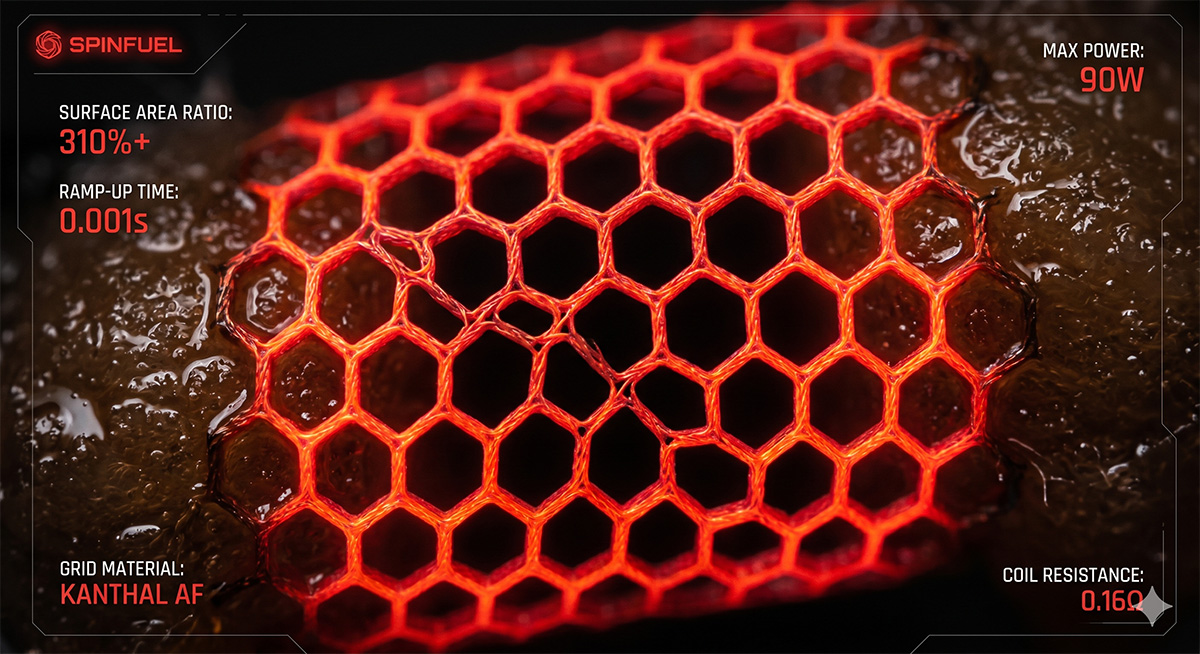
The round wire coil had a good run. It’s over. Here’s why mesh won — and why it was never really a close contest.
The Death of the Wire
For the better part of a decade, the coil inside your tank was a wire. Kanthal, Stainless Steel 316L, Ni80 — the material changed, but the fundamental geometry didn’t. You took a length of resistive wire, wound it into a tight little cylinder, threaded cotton through the center, and called it done. The wire heated up, the cotton got saturated, and vapor happened. It worked. Millions of vapers used it. And it had a fatal flaw that nobody talked about honestly enough: it was an engineering compromise masquerading as a finished product.
The problem was surface area — or more precisely, the brutal lack of it. A coiled wire is a cylinder. Its contact with the surrounding cotton wick is limited to the exterior of those coil loops, and within those loops, heat distribution was always uneven. The innermost turns ran hotter than the outer edge. The top of the coil ran hotter than the bottom. Vapers gave this problem a name — “hot spots” — and spent years chasing solutions: contact coils, spaced coils, twisted builds, parallel builds, alien wire. All of it brilliant. All of it a workaround.
The philosophy of round wire vaping was, at its core, “Heat the Wire and Hope for the Best.” Mesh changed the question entirely. The new philosophy became: Maximize the Surface. And once you frame it that way, the old approach looks almost quaint.
The Anatomy of Mesh
Strip a mesh coil down and you’re looking at a flat, perforated strip of resistive metal — typically Kanthal A1, SS316L, or Ni80 — pressed or woven into a honeycomb or grid pattern. The strip spans the width of the coil housing and sits flush against the cotton wick across its entire face. It looks almost too simple. That simplicity is precisely the point.
The physics are not complicated, but they are decisive. A flat surface pressed against a saturated wick transfers heat across every single contact point simultaneously. There is no “inner coil” running hotter than the “outer coil” because there is no inner or outer — there is only the face, and every millimeter of it is working. Compare that to a traditional cylindrical coil, where the geometry itself guarantees that some portions of wire will be at a higher temperature than others, and you start to understand why hot spots were never really a fixable problem with round wire. They were baked into the shape.
Then there’s ramp-up time — the interval between firing the mod and the coil reaching its operating temperature. Traditional coils, depending on gauge and build, could take several hundred milliseconds to fully come up to heat. Mesh strips are thin. They have low thermal mass. The entire surface reaches temperature almost instantaneously after you fire. What this means in practice is immediate, consistent vapor from the first pull — no lead-in, no gradual buildup, no waiting for the coil to “wake up.” The draw you get at second one is the draw you get at second five.
Performance Benchmarks: What Mesh Actually Delivers
Talk to any serious reviewer and flavor fidelity is the first thing they mention about mesh. This isn’t marketing language — it has a real thermal basis. E-liquid is a complex mixture of flavor molecules, PG, VG, and nicotine, each with different vaporization points. When a coil has hot spots, the areas running above optimal temperature will scorch the more delicate flavor compounds before they can be delivered cleanly. The result is a muted, slightly burnt edge to complex flavors — particularly noticeable in creamy dessert profiles and subtle fruit blends.
Mesh eliminates that scorching by keeping temperature distribution uniform. Every molecule of e-liquid hitting the coil face encounters the same thermal environment. What the flavor artist put in the bottle is what arrives at your palate. The Lab has reviewed hundreds of disposables and sub-ohm tanks over the years, and the flavor gap between a quality mesh coil and a well-built traditional coil is not subtle — it’s the difference between reading a sentence and reading it through frosted glass.
Coil longevity is the second major benchmark, and it’s where mesh earns long-term loyalty from cost-conscious vapers. Traditional coils degrade unevenly — hot spots burn cotton faster than cooler sections, creating dry patches that accelerate degradation and introduce those bitter, charred notes you’ve learned to dread. Mesh extends coil life to two to three times that of a conventional build under equivalent usage, simply because the cotton wears evenly across its full contact surface. There’s no single failure point, so there’s no sudden cliff where the coil goes from acceptable to ruined overnight.
Finally, there’s aerosol density — the character and texture of the vapor itself. Mesh produces what experienced vapers describe as a smoother, denser cloud with better “body.” The explanation is straightforward: because heat is distributed evenly across a large contact surface, vaporization happens simultaneously across a wider area of wick. More e-liquid molecules are converted to vapor in each firing cycle, and they’re produced at a consistent temperature. The result is a cloud with a silkier texture and more apparent weight — less “whispy” than traditional coil output, more substantial in the mouth and lungs.
The Multi-Mesh Revolution
Once the industry understood what a single mesh strip could do, the obvious next question was: what happens if you stack them? The answer, as it turned out, was “quite a lot.”
Dual-mesh configurations arrived first, pairing two strips in close proximity to effectively double the heating surface while keeping resistance manageable. Triple-mesh followed for high-wattage applications where sheer vapor volume was the goal. Quad-mesh designs — four strips operating in concert — are now firmly in the mainstream of premium sub-ohm tanks and high-performance disposables. What began as an incremental improvement over traditional coils has become its own architecture, with an entire engineering vocabulary around strip spacing, grid density, and inter-coil airflow dynamics.
Heading into 2026, multi-mesh is not a premium feature — it’s the expected baseline. The sub-ohm tanks sitting at the top of every credible reviewer’s list right now are running dual or triple mesh as standard. High-performance disposables — the kind pushing 20,000 to 100,000 puffs — have adopted mesh almost universally, because at scale, the longevity advantages are not optional. A hot-spot-prone coil in a device rated for 50,000 puffs would fail spectacularly long before the e-liquid ran out. Mesh is what makes modern puff counts credible.
The optimization work happening now is refinement rather than revolution — tighter grid tolerances, improved strip-to-cotton contact geometries, material blends that balance conductivity against longevity. But the foundational architecture is locked in. Nobody in this industry is going back to wound wire as the primary heating element in performance hardware. That argument ended years ago.
The Future of Thermal Extraction: The Lab’s Verdict
Here is where we land after twenty-plus years of watching this industry iterate: mesh is not a chapter in the story of coil development. It is the final chapter.
The round wire era was defined by clever workarounds to a fundamental geometric limitation. Every exotic coil build — every Clapton, every Alien, every fused Clapton with hand-cut staple wrap — was an attempt to add surface area to a cylinder. Magnificent attempts, many of them. But they were all fighting the same physics that mesh simply sidesteps by using a different shape entirely.
What mesh delivered — and what nothing before it fully achieved — was even thermal distribution as a manufacturing default rather than a builder’s art. You don’t need to be a coil-building enthusiast to benefit from mesh. You need to buy the right tank or device, and the engineering does the rest. That democratization matters. The best vape experience is no longer gated behind hours of build skill. It’s sitting in a coil head at your local shop for a few dollars.
Could something supplant mesh? The Lab isn’t dismissive — induction heating and solid-state thermal elements are research-stage possibilities. But they remain solutions looking for a mass-market problem that mesh has already largely solved. For resistance-based heating, which is what every sub-ohm tank and the vast majority of disposables on the market use today, mesh is the final evolution. The physics have been satisfied. The platform is mature.
The wire is dead. Mesh won. And vaping is better for it.
— Spinfuel.com | The Lab
Sterling Grey
Founder & Lead Researcher, Spinfuel Lab
With over 15 years in the industry, Sterling leads the Spinfuel Lab’s technical evaluation and engineering analysis divisions.