
Nicotine Salts vs. Freebase:
The Technical Difference
Chemical Engineering • Absorption Science
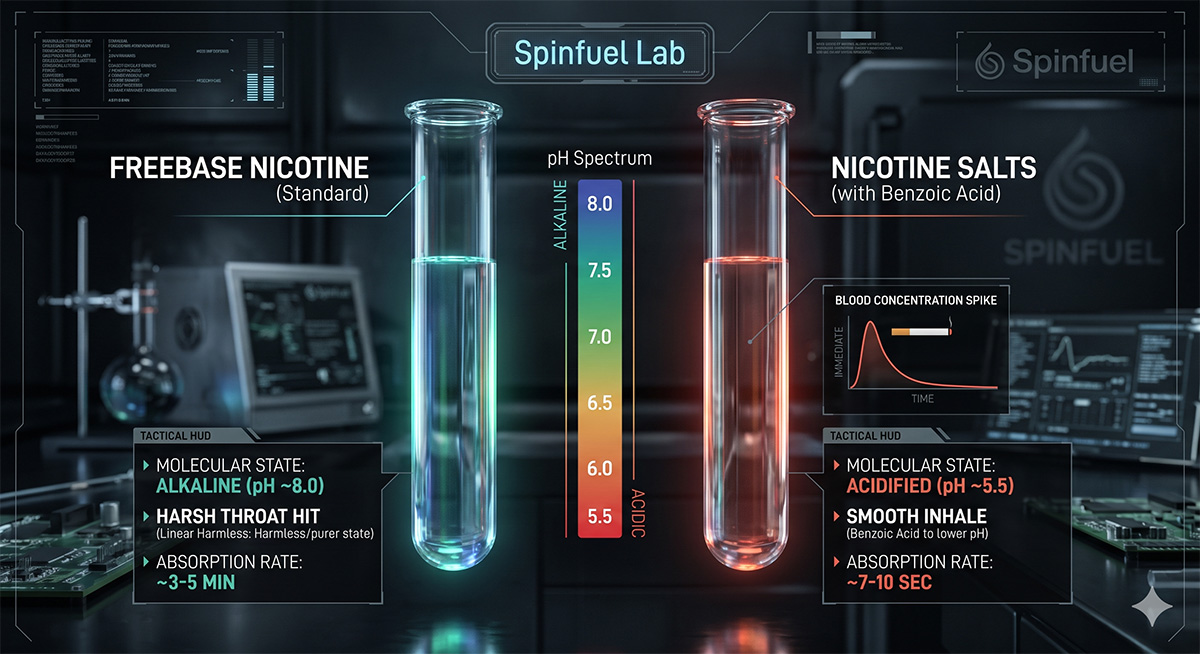
What separates these two molecules, why it matters for your hardware, your health, and your experience — and how to choose correctly.
Introduction: The Death of the Throat Hit
Before 2015, the vaping industry was defined by a practical limitation: you couldn’t vaporize high concentrations of nicotine (24mg+) without experiencing excruciating physical pain in the throat and lungs. This barrier kept millions of heavy smokers from fully transitioning to vaping. The standard of the era was Freebase Nicotine, the traditional molecule which, due to its alkaline nature, delivered a powerful “throat hit” that became a point of pride for some vapers but a technical failure for most smokers.
The revolution was chemical, not mechanical. The invention of Nicotine Salts, led by companies like PAX Labs (creator of JUUL), discovered that adding a food-grade acid — typically Benzoic Acid — to Freebase Nicotine could fundamentally lower the substance’s pH level. Lowering the pH did more than reduce the harshness; it created a stable molecule that vaporized at a lower temperature and entered the bloodstream far more rapidly than any previous aerosolized nicotine product.
The consequences of that discovery reshaped the entire vaping industry within a few years, and its effects are still being felt in every pod system, every salt nic bottle, and every hardware decision vapers make today. This guide covers the chemistry, the experience, the hardware requirements, the appropriate nicotine levels for different users, and the safety considerations that anyone using either product category should understand.
INTERNAL LINK NOTE: Anchor point: Link to Spinfuel Knowledge Base overview page once live.
I. The Chemistry Explained
Freebase Nicotine: The Original Molecule
Freebase nicotine is nicotine in its purest chemical form — the unprotonated, free base state of the molecule. The term “freebase” refers to a chemical process, originally developed by Philip Morris in the 1960s, that strips away the naturally occurring salts in tobacco leaf nicotine to produce a more potent, more volatile compound. The same process is used in the production of other freebase alkaloids, though in the context of nicotine it was pioneered for cigarette manufacturing long before the vaping industry existed.
In its freebase state, nicotine is highly alkaline, typically registering a pH between 7 and 8. That alkalinity is directly responsible for the throat hit vapers associate with higher-strength e-liquids. When an alkaline substance makes contact with the sensitive mucous membranes of the throat and airways, it produces an irritation response — the catch and burn that cigarette smokers recognize and that many early vapers sought to replicate. At concentrations of 6mg and below, freebase nicotine is manageable for most users. At 12mg and above, the harshness becomes a limiting factor. At 24mg and beyond, it becomes genuinely unpleasant for the majority of users, regardless of device or airflow setup.
The other consequence of freebase nicotine’s alkalinity is its absorption rate. Freebase nicotine does cross into the bloodstream through the lung tissue, but the rate of absorption is moderate compared to what the body experiences from a cigarette — a gap that frustrated many smokers attempting to transition to vaping in the pre-salt era.
INTERNAL LINK NOTE: Anchor point: Link to Spinfuel’s PG/VG ratio guide when published — relevant to how freebase nicotine interacts with high-VG e-liquids.
Nicotine Salts: The pH Revolution
In chemistry, a salt is formed when an acid and a base react together. Nicotine, being a base, forms a salt compound when combined with an acid. In tobacco leaf, nicotine exists naturally in a salt form — bound to organic acids present in the plant. The freebase process removes those acids. Nicotine salt e-liquid chemistry essentially reverses that step in a controlled way, reintroducing a specific acid to produce a stable, smoother compound.
The acid of choice in the majority of commercial nicotine salt e-liquids is Benzoic Acid — a naturally occurring, food-grade organic compound found in many fruits and used as a preservative in a wide range of food products. When Benzoic Acid is introduced to freebase nicotine, it forms a nicotine benzoate salt. The reaction lowers the pH of the nicotine solution, bringing it closer to the neutral range and substantially reducing the alkaline irritation that makes high-concentration freebase unpleasant to inhale.
The result is a molecule with three distinct advantages over its freebase counterpart at high concentrations: it is significantly smoother to inhale, it vaporizes efficiently at lower temperatures, and it absorbs into the bloodstream more rapidly. That third point — absorption speed — is arguably the most commercially significant, because it addresses the core reason heavy smokers found early vaping unsatisfying. A cigarette delivers nicotine to the brain in approximately seven to ten seconds. Pre-salt e-liquids at practical concentrations could take several minutes to deliver comparable nicotine saturation. Nicotine salts, particularly at concentrations of 35mg to 50mg, close that gap substantially.
What Benzoic Acid Actually Does — and What It Doesn’t
It is worth being precise about the role of Benzoic Acid, because it is sometimes mischaracterized in industry writing. Benzoic Acid does not make nicotine “stronger” at a given concentration level. A 20mg nicotine salt and a 20mg freebase e-liquid contain the same quantity of nicotine by weight. What the Benzoic Acid changes is the delivery mechanism and the experience of inhalation — not the absolute nicotine content.
What the acid does do is enable the practical use of much higher nicotine concentrations. 50mg of freebase nicotine in an e-liquid would be essentially unusable for most people due to the throat response. 50mg of nicotine in a well-formulated benzoate salt is inhaled smoothly by millions of people daily. The salt form doesn’t add nicotine — it unlocks concentrations that were previously impractical.
It also introduces one variable worth noting: Benzoic Acid produces benzene as a combustion byproduct when burned at high temperatures. In the context of vaping — where vaporization, not combustion, is the operative process — the temperatures involved are generally too low to produce meaningful benzene output. However, this is one of the reasons that nicotine salt e-liquids are specifically formulated for low-wattage, low-temperature devices. Using salt nic in a high-wattage sub-ohm tank does not produce good results for reasons of both chemistry and experience, a point we will return to in the hardware compatibility section.
INTERNAL LINK NOTE: Anchor point: Link to Spinfuel’s coil temperature and wattage guide when published.
II. The Experience Compared
Throat Hit
This is the most immediately noticeable difference between the two nicotine forms. Freebase nicotine at moderate to high concentrations produces a distinct physical sensation in the throat — a tightening and slight burn that longtime vapers and former smokers often describe as satisfying. At low concentrations (3mg, 6mg), the throat hit is mild. At 12mg it becomes assertive. At 18mg and above in most hardware, it becomes harsh enough to limit use for many people.
Nicotine salts at equivalent or even significantly higher concentrations produce a notably smoother draw. A 35mg salt nic in a compatible pod device delivers a throat experience that many users describe as closer to a cigarette — present but not punishing. A 50mg salt nic, in the right hardware, is smooth enough for regular use by ex-smokers who would have found even 18mg freebase uncomfortable. This is the fundamental experiential trade that the salt form offers: more nicotine, less harshness.
Absorption Speed and Nicotine Satisfaction
The faster absorption of nicotine salts is well documented and represents one of the most practically significant differences between the two forms. The protonated state of the nicotine salt molecule allows it to cross cell membranes more efficiently in the lung tissue, accelerating the rate at which nicotine enters the bloodstream and reaches receptor sites in the brain.
For former smokers, this matters because nicotine satisfaction is as much about speed as quantity. The brain’s reward response to nicotine is partially conditioned on the speed of delivery — a slow rise in nicotine blood levels produces a different subjective experience than a rapid spike, even if the eventual concentration is the same. Nicotine salts more closely replicate the rapid delivery curve of a cigarette. Freebase nicotine at typical vaping concentrations produces a slower, more gradual saturation that many heavy former smokers find less completely satisfying as a substitute.
Flavor Profile
The pH difference between freebase and salt nicotine has a secondary effect on flavor perception. The higher alkalinity of freebase nicotine can interact with flavor compounds in the e-liquid, particularly at concentrations above 6mg, softening or slightly distorting certain flavor notes — particularly subtle fruit profiles and lighter dessert flavors. Experienced mixers formulating for freebase nicotine account for this in their recipes.
Nicotine salts, operating at a lower pH, are generally considered more neutral in their interaction with flavor molecules. Many vapers and reviewers report that salt nic e-liquids produce slightly cleaner flavor reproduction, particularly at higher nicotine concentrations where freebase alkalinity would otherwise be a confounding variable. This is one reason premium e-liquid manufacturers often release both a freebase and a salt nic version of the same flavor line rather than treating them as interchangeable.
Vapor Production
Freebase nicotine is the natural companion to high-VG, high-vapor-output e-liquids. Sub-ohm vaping — the large-cloud, high-wattage style of vaping that dominated the mid-2010s and remains a significant segment of the market — almost exclusively uses freebase nicotine at low concentrations, typically 1.5mg to 6mg. The high wattages involved in sub-ohm vaping would make any meaningful concentration of salt nic uncomfortable and potentially unsafe to use.
Nicotine salts are not designed for vapor production. They are designed for nicotine delivery. The devices they are paired with — pod systems, low-wattage AIOs — produce modest, mouth-to-lung draws with relatively limited aerosol volume. This is not a deficiency of the salt form; it is appropriate to its purpose. The tradeoff is explicit: less vapor, faster and stronger nicotine delivery. For the target audience of heavy former smokers and nicotine-dependent vapers, that is generally the correct trade.
INTERNAL LINK NOTE: Anchor point: Link to Spinfuel’s sub-ohm vaping guide and MTL vs DTL inhale guide when published.
III. Hardware Compatibility
Why the Wrong Combination Matters
Using nicotine salt e-liquid in the wrong device is one of the most common mistakes new vapers make, and it has real consequences. The issue is not merely that the experience will be suboptimal — it is that the combination can be genuinely unpleasant and, at high salt concentrations in high-wattage hardware, can deliver nicotine at a rate that causes dizziness, nausea, and rapid heart rate. Understanding which nicotine form belongs in which hardware is not optional information for anyone buying e-liquid.
Freebase Nicotine: Matched to High-Wattage, Sub-Ohm Hardware
Freebase nicotine belongs in high-wattage, sub-ohm vaping hardware. This category includes:
- Sub-ohm tanks running coils rated below 1.0 ohm
- Rebuildable atomizers (RDAs, RTAs) at moderate to high wattages
- Box mods and regulated devices typically running 40W and above
- High-VG (70VG/30PG and above) e-liquid formulations
In these devices, the high wattage and low resistance produce operating temperatures that would over-deliver nicotine at salt nic concentrations and cause an unpleasant reaction. Freebase nicotine at 3mg to 6mg in this hardware produces the right nicotine delivery curve — gradual, moderate, sustained — for the long vaping sessions characteristic of cloud-forward, recreational vaping.
Using nicotine salt in sub-ohm hardware is strongly inadvisable. Even a 25mg salt nic in a 50W sub-ohm tank would deliver nicotine at a rate that would cause immediate physical discomfort in most users. The chemistry is not designed for that thermal and power environment.
INTERNAL LINK NOTE: Anchor point: Link to Spinfuel’s sub-ohm tank reviews hub when live.
Nicotine Salts: Matched to Low-Wattage, High-Resistance Pod Systems
Nicotine salts belong in low-wattage, mouth-to-lung devices. This category includes:
- Closed-system pod devices (pre-filled pods)
- Refillable pod systems running coils rated 0.8 ohm and above
- Low-wattage AIO devices typically running 10W to 25W
- Higher-PG (50PG/50VG or higher-PG) e-liquid formulations
The lower wattages and higher coil resistances in these devices produce lower operating temperatures, which is precisely the environment nicotine salt e-liquids are formulated for. The smaller vapor volume produced by these devices means nicotine delivery per puff is controlled — the high concentration of the salt nic is offset by the modest aerosol output per draw.
The Crossover Zone: 20mg–25mg Salt Nic in Versatile Pods
There is a middle ground that has emerged as the vaping hardware market has matured. Mid-range salt nic concentrations — typically 20mg to 25mg — have enough smoothness for direct use in pod systems while delivering a slightly more measured nicotine dose than 35mg to 50mg products. Several modern pod systems offer adjustable wattage between roughly 15W and 30W, which allows some flexibility in how a mid-strength salt nic performs.
For vapers who want a more casual pod experience without the intensity of high-concentration salt nic, this crossover zone is worth exploring. It is also increasingly the recommended entry point for smokers making their first transition to vaping, as the nicotine delivery is satisfying without being as aggressive as 50mg formulations.
INTERNAL LINK NOTE: Anchor point: Link to Spinfuel’s pod system reviews hub and best pod systems guide when published.
IV. Recommended Nicotine Levels by User Type
Nicotine level selection is not one-size-fits-all. The right concentration depends on three factors: your current or prior smoking history, the type of hardware you’re using, and your personal sensitivity to nicotine. The following framework is a general guide. Individual responses to nicotine vary significantly, and these recommendations should be treated as starting points rather than prescriptions.
INTERNAL LINK NOTE: Anchor point: Link to Spinfuel’s nicotine safety and harm reduction guide when published.
Heavy Smokers Transitioning to Vaping (20+ Cigarettes Per Day)
This group has the highest nicotine dependency and the most to gain from salt nic technology. A 35mg to 50mg nicotine salt in a compatible pod system is generally the most effective starting point for heavy smokers. The rapid absorption and smooth delivery of high-concentration salt nic provides the closest approximation to the nicotine curve of cigarette smoking, which is the key variable in successful transitions. Heavy smokers who begin with freebase nicotine at lower concentrations often report that vaping feels unsatisfying in comparison to cigarettes, which undermines the transition.
Moderate Smokers (10–20 Cigarettes Per Day)
Moderate smokers generally do well with salt nic in the 20mg to 35mg range, or with freebase nicotine at 12mg in a compatible MTL device. The choice between the two often comes down to hardware preference. If the preference is for a small, discreet pod device, 20mg to 35mg salt nic is the natural fit. If the preference is for a slightly more substantial device with more airflow flexibility, a good MTL tank with 12mg freebase will deliver comparable satisfaction.
Light and Social Smokers (Under 10 Cigarettes Per Day)
Light smokers typically have lower nicotine dependency and are better served by lower concentrations. Salt nic in the 10mg to 20mg range works well in pod systems. Freebase nicotine at 6mg in a versatile MTL or restricted sub-ohm device is also a reasonable option. At this level of nicotine need, the performance gap between freebase and salt nic narrows considerably, and personal preference in flavor, hardware, and draw style can guide the decision more than nicotine delivery requirements.
Long-Term Vapers Looking to Reduce Nicotine
Vapers who have been using nicotine-containing e-liquids for some time and want to reduce their intake typically follow a stepwise reduction approach. For those on freebase nicotine, this usually means moving from 6mg to 3mg, then to 1.5mg, and eventually to 0mg. For those on salt nic, the reduction path typically involves stepping down through 25mg, then 20mg, then transitioning to a lower-concentration freebase product. Moving from high-concentration salt nic directly to very low freebase without an intermediate step often leads to unsatisfying results and an increased risk of reverting to higher concentrations.
Sub-Ohm and Cloud-Oriented Vapers
Dedicated sub-ohm vapers, particularly those using high-wattage devices primarily for vapor production and flavor, typically use freebase nicotine at 3mg or below. At high wattages, even 6mg freebase can become harsh on extended sessions. Nicotine salt has no practical role in this usage pattern and should not be used in sub-ohm hardware.
Nicotine-Free Vaping (0mg)
A meaningful segment of vapers use nicotine-free e-liquid entirely — some as the final step in a nicotine reduction program, others who vape primarily for the sensory experience of flavor and vapor production. 0mg e-liquids are available in both PG/VG base formulas compatible with sub-ohm hardware and in higher-PG formulas compatible with pod systems. There is no nicotine form consideration at 0mg beyond the base liquid ratio and its compatibility with the intended hardware.
V. Safety Considerations
Nicotine is a pharmacologically active compound with real physiological effects and genuine risks at inappropriate concentrations or in inappropriate contexts. The following safety considerations apply to both freebase and salt nicotine products, with specific notes where the risk profile differs between the two forms.
Nicotine Overdose Risk — Particularly Relevant to Salt Nic
The smoothness of nicotine salt e-liquids at high concentrations creates a risk that does not exist to the same degree with freebase products: it is easy to inadvertently over-consume nicotine before experiencing the discomfort that would normally signal excess. With high-concentration freebase nicotine, the throat hit and harshness serve as an involuntary warning system — the experience becomes unpleasant before nicotine toxicity becomes a concern. High-concentration salt nic removes that warning signal.
Symptoms of nicotine overconsumption include dizziness, nausea, headache, elevated heart rate, and in more serious cases, vomiting and difficulty breathing. New users of salt nic products — particularly those starting at 35mg to 50mg concentrations — should begin with short, spaced-out sessions to gauge their response before increasing frequency.
Particular caution is warranted for:
- Non-smokers and former non-smokers with low nicotine tolerance
- Young adults and adolescents, for whom nicotine dependence can develop rapidly
- Individuals with cardiovascular conditions, for whom nicotine’s vasoconstrictive effects present additional risk
- Anyone combining vaping with other nicotine products (patches, gum, pouches), where cumulative intake can exceed safe levels
Pregnancy and Medical Conditions
Nicotine in any form is contraindicated during pregnancy. Nicotine crosses the placental barrier and is associated with adverse developmental outcomes. This applies equally to freebase and salt nicotine products — the delivery mechanism does not change the underlying pharmacology. Anyone who is pregnant or planning pregnancy should consult a physician regarding cessation support options rather than continuing nicotine use in any form.
Individuals with hypertension, cardiac arrhythmia, or other cardiovascular conditions should discuss nicotine vaping with their physician, particularly before using high-concentration salt nic products. While vaping is generally considered to carry a significantly lower cardiovascular burden than smoking due to the absence of combustion, nicotine itself remains a vasoconstrictor and cardiac stimulant regardless of delivery method.
Liquid Handling and Storage
Nicotine in liquid form — particularly at the high concentrations found in salt nic products — is toxic on skin contact and can be absorbed transdermally. Bottles should be kept away from children and pets at all times. Childproof caps, while standard on most commercial products, should be treated as a minimum precaution rather than a complete safeguard. High-concentration salt nic e-liquid should be stored out of reach in a location inaccessible to children.
E-liquids should be stored away from direct sunlight and heat, which can degrade flavor compounds and, over time, the nicotine itself. A cool, dark location is adequate for most products. Long-term storage in a refrigerator can extend shelf life, though products should be allowed to return to room temperature before use to ensure proper wicking viscosity.
Regulatory Awareness
Nicotine salt product regulations vary by jurisdiction. In the United States, the FDA has authority over nicotine-containing e-liquid products under the deeming regulations. Maximum nicotine concentrations permitted for sale, packaging requirements, and age verification standards differ between states and have continued to evolve. In the European Union, the TPD (Tobacco Products Directive) caps nicotine concentration in e-liquids at 20mg/ml. In the UK post-Brexit, the same 20mg/ml cap applies under domestic regulations. Vapers purchasing products internationally should be aware that concentration standards differ and that products available in the US market at 50mg may exceed legal limits in other jurisdictions.
INTERNAL LINK NOTE: Anchor point: Link to Spinfuel’s vaping regulations and legal landscape guide when published.
VI. Which Should You Choose? A Decision Framework
The choice between freebase and salt nicotine is determined by four variables: your device, your nicotine needs, your smoking history, and your vaping style. Working through each in order generally produces a clear answer.
Choose Nicotine Salts if: you are transitioning from smoking and want the closest approximation to cigarette satisfaction; you prefer small, discreet pod devices; you use a low-wattage, mouth-to-lung setup; you find freebase nicotine harsh at the concentrations you need; or you require rapid nicotine delivery.
Choose Freebase Nicotine if: you use a sub-ohm or high-wattage device; you vape primarily for flavor and vapor production rather than nicotine delivery; you have already reduced your nicotine dependency to lower concentrations; or you prefer the physical throat hit sensation that freebase provides at moderate concentrations.
Consider the 20–25mg Salt Nic middle ground if: you are newer to vaping and unsure of your nicotine needs; you want the smoothness of salt nic without the intensity of 50mg products; or you are stepping down from higher concentrations toward lower nicotine intake.
Neither form is inherently superior. They are optimized for different devices, different use cases, and different users. The widespread availability of both means there is no reason to use a product in the wrong context — and every reason to understand which context is yours.
INTERNAL LINK NOTE: Anchor point: Link to Spinfuel’s beginner’s guide to vaping setup when published. Link to Spinfuel’s best pod systems guide when published.
The Lab’s Verdict
The invention of nicotine salts solved a problem that had constrained the vaping industry’s ability to serve heavy smokers since the technology’s inception. The pre-salt era was defined by a ceiling — nicotine concentrations that were pharmacologically sufficient to satisfy a heavy smoker were simply not tolerable to inhale. The benzoate salt chemistry lowered that ceiling out of the picture entirely and, in doing so, made vaping a practical option for a population that had previously found it an unsatisfying substitute for cigarettes.
Freebase nicotine did not become obsolete in the process. For sub-ohm hardware, for cloud-oriented vaping, for vapers who have already stepped down to low nicotine concentrations, and for those who specifically want the physical throat hit sensation, freebase remains the correct choice. The two forms are complements, not competitors.
What the knowledge base entry on this topic should leave you with is a clear principle: the nicotine form and the hardware are a system, not two independent choices. Choose salt nic for the wrong device and the experience will range from unpleasant to potentially unsafe. Choose freebase at too low a concentration for your nicotine needs and the vaping experience will feel inadequate, which is the most reliable predictor of a return to smoking.
Get the pairing right, and both technologies deliver on their respective promises. That’s the only rule that matters here.
INTERNAL LINK NOTE: Anchor point: Link to Spinfuel’s full Knowledge Base index when published. Link to mesh coil evolution article for readers interested in hardware context.
— Spinfuel.com | Knowledge Base
Sterling Grey
Founder & Lead Researcher, Spinfuel Lab
With over 15 years in the industry, Sterling leads the Spinfuel Lab’s technical evaluation and engineering analysis divisions.
