
A Eulogy Nobody Asked For
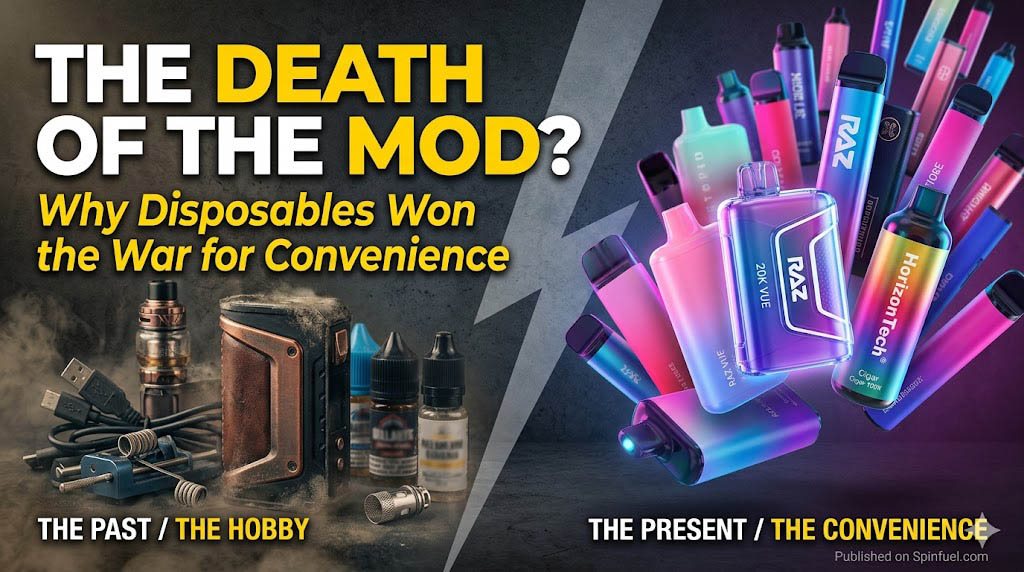
There’s a drawer in a lot of vapers’ homes — maybe yours — that tells the whole story. Open it up and you’ll find a Voopoo Drag gathering dust next to a tangle of coil heads, a half-empty bottle of premium nicotine salt e-liquid, a glass tank that was a genuine pain to fill properly, and a USB cable for a device you haven’t touched in eight months. That gear cost real money. It took time to learn. And somewhere along the way, you stopped using it.
Not because it stopped working. Because a $15 disposable was just… easier.
The disposable vape didn’t sneak up on the vaping industry — it ran straight at the front door, broke it down, and moved in while the old guard was still arguing about wattage curves and mesh coils. And now, in 2026, it owns the market. Walk into any gas station, convenience store, or smoke shop, and the walls are lined with colorful, compact, pre-filled devices that require zero knowledge to use. Walk into a dedicated vape shop, and the mod section — once the proud centerpiece — has quietly shrunk.
The convenience war is over. Disposables won. But winning a war and winning an argument aren’t the same thing. The real question isn’t how disposables took over — it’s what we traded away when they did.
Tired of the noise?
Join 152 other insiders for the weekly Lab Dispatch.
A Brief History of the Mod Era’s Golden Age
To understand what was lost, you have to understand what was built. The arc of vaping from the early 2010s through the mid-2020s is genuinely one of the more fascinating technological grassroots stories in consumer electronics. It started with cigalikes — those pen-shaped devices designed to mimic the look of a cigarette — and evolved, rapidly and almost organically, into a full-blown hardware hobby.
Box mods arrived and changed everything. Suddenly, vapers had wattage control, temperature control, replaceable 18650 batteries, and the ability to fine-tune a vape like a piece of audio equipment. After box mods came regulated mods with advanced chipsets — think the Voopoo Gene chip, or the DNA boards from Evolv — that offered precision a cigarette could never dream of. Then came squonkers, which fed e-liquid directly to a rebuildable atomizer from a squeezable bottle inside the mod. Then high-end rebuildable tank atomizers, or RTAs, where you built and wicked your own coils.
The vocabulary alone tells you this was a hobby. Clapton coils. Fused Claptons. Staple staggered fused Clapton. Kanthal versus nichrome versus stainless steel. Ohm’s law. Parallel coil builds. Cotton wicking technique. These weren’t things you needed to know to use the product — they were things enthusiasts wanted to know, competed over, shared on forums, and made YouTube videos about.
Brands like Vaporesso, Voopoo, Lost Vape, GeekVape, and Aspire built genuine fanbases. People had favorite chipsets the way they have favorite car engines. Subreddits dedicated to coil builds had hundreds of thousands of members. It was, by any reasonable measure, a thriving hobbyist culture.
And then the ground shifted.
The Disposable Disruption — How It Actually Happened
The disposable vape’s origin story is usually traced back to JUUL, which launched in 2015 with a dead-simple design, pre-filled pods, and nicotine salt technology that delivered a cigarette-like throat hit at a level basic e-liquids couldn’t match. JUUL didn’t invent the disposable — but it proved the mass market wanted simplicity above all else.
The true inflection point came a few years later with Puff Bar. Here was a completely self-contained device, no charging, no refilling, 300 puffs, done. Throw it away. At the time, the established vaping community largely dismissed it. The sentiment was something like: this is a cheap novelty for people who don’t know better. Real vapers use proper gear.
That dismissal turned out to be one of the great miscalculations in consumer product history.
What happened next was a specification arms race unlike anything the category had seen. 300 puffs became 1,500. Then 5,000. Then 10,000. Then 20,000. Then 50,000. As of 2026, devices like the RAZ VUE 50K and the staggering HorizonTech Cigar 100K exist as legitimate, rechargeable, refillable disposables that deliver puff counts no box mod user would have dreamed of a decade ago. The category reinvented itself several times over in roughly four years.
Flavor variety became another weapon. Where e-liquid brands worked on months-long development cycles, disposable manufacturers could iterate flavors in weeks. The result was an explosion of options — some genuinely excellent, many forgettable — that made every trip to the vape store feel like a new menu had arrived. And price psychology did the rest. At $15 to $25 a device, the entry cost felt trivial, even if the long-term math told a very different story.
The Real Cost Breakdown: Mod + E-Liquid vs. Disposables Over 12 Months
Based on average-use estimates. Mod assumes moderate coil replacement and e-liquid consumption.
|
|
Mod + E-Liquid | Disposables |
| Startup Cost | $60–$120 | $15–$25 |
| Monthly Ongoing | $20–$40 | $80–$160 |
| 12-Month Total | $300–$580 | $975–$1,945 |
| Maintenance | Coil changes, cleaning | None — discard and replace |
Why Convenience Beats Everything (Every Time)
Here’s an uncomfortable truth for anyone who spent real time in the mod hobby: the friction was always there. We just convinced ourselves it was part of the experience.
A good parallel is the smartphone camera versus the DSLR. Every serious photographer will tell you a dedicated camera with a quality lens beats a phone sensor in almost every technical category. They’re right. And most people, including many of those same photographers, reach for their phone nine times out of ten. Because it’s in their pocket. Because it’s immediate. Because good enough plus zero friction beats technically superior plus effort every single time in daily life.
The mod experience, honest about it, had real friction. Coils needed to be primed or you’d get a dry hit that ruined your morning. Tanks leaked — some reliably, some randomly, always at the worst time. Batteries needed to be charged, wrapped, checked for damage, and eventually replaced. E-liquid needed to be bought, carried, poured carefully into a tiny fill port, and allowed to settle. If you had a rebuildable, add coil-building, resistance checking, and cotton wicking to that list.
None of this was insurmountable. Enthusiasts genuinely enjoyed much of it. But for the person who simply wanted to stop smoking cigarettes and find something that worked without becoming a part-time engineer, the disposable was revelatory. Open the package. Inhale. Done.
Nicotine salt technology was the final piece of the puzzle. Smooth at high nicotine concentrations, delivering satisfaction quickly, nic salts made high-mg disposables feel less like a novelty and more like a genuine cigarette alternative. The mass market didn’t need a 200-watt Sub-Ohm cloud machine. It needed something that worked, immediately, without a tutorial.
The Mass Market vs. The Enthusiast: A Split That Defines the Modern Era
If you want to understand where vaping stands in 2026, the most useful frame isn’t growth charts or regulatory headlines. It’s the craft beer analogy.
When macro lagers dominated beer, the conventional wisdom was that drinkers just wanted cheap, cold, consistent, and easy. Then craft beer emerged and proved there was an audience willing to pay more and think harder about what they were drinking. But craft beer didn’t kill Bud Light. Bud Light is still one of the best-selling beers on the planet. What craft beer did was carve out a dedicated, passionate, and profitable niche alongside the dominant product — one that has its own culture, its own vocabulary, and its own economics.
That’s exactly what’s happening with vaping. The mass market found its Bud Light: the disposable. Convenient, consistent, low-commitment, widely available. And the mod community has become craft beer — smaller in scale, richer in experience, sustained by enthusiasts who genuinely care about the craft.
Walk into a well-stocked vape shop today and you’ll see this split in real-time. Floor space that once belonged to mod kits and tank starter setups has shifted heavily toward the disposable wall, which now often runs the full length of the store. But the glass case with the high-end regulated mods, the rebuildable atomizers, the premium e-liquid brands — it’s still there. Smaller, maybe. But there.
Who’s buying mods in 2026? It’s a tighter demographic than before: experienced vapers who know exactly what they want and why, flavor chasers who understand what a quality tank and a premium e-liquid can do that no disposable can replicate, cloud enthusiasts, and hobbyists who build coils the way some people restore vintage cars. Not a mass market. But a real one.
|
Still Worth It? 5 Reasons to Try a Mod in 2026 • Flavor depth: A well-built tank with quality e-liquid delivers complexity no disposable can match. • Long-term savings: The math is clear — mod users spend a fraction of what disposable-only vapers spend annually. • Customization: Wattage, airflow, coil type, and e-liquid give you variables to dial in your perfect vape. • Sustainability: Reusable hardware dramatically reduces waste compared to single-use devices. • Community: The mod and rebuildable communities are smaller than before, but more engaged and knowledgeable than ever. |
What Was Actually Lost
Let’s be honest about this part, because the “disposables won” narrative gets told as pure consumer preference — and it is, mostly — but something genuinely valuable went with it.
The ritualistic dimension of vaping as a hobby has nearly vanished from mainstream conversation. There was something tactile and considered about the mod experience: choosing your e-liquid, deciding on a coil, adjusting wattage, taking a moment to actually taste what you’re vaping. It wasn’t for everyone, and the industry was right to serve people who didn’t want that experience. But it existed. For a lot of people, it was the thing that made vaping feel like an upgrade from smoking rather than a sideways step.
Flavor complexity is the most concrete casualty. This isn’t audiophile snobbery — it’s chemistry. A quality Sub-Ohm tank running at the right wattage with a premium e-liquid produces vapor that is simply in a different category from what a disposable delivers. The subtleties in a well-crafted custard or a layered fruit blend open up in ways that disposable hardware, constrained by its form factor and coil limitations, cannot reproduce. Vapers who have never experienced that genuinely don’t know what they’re missing.
Then there’s the sustainability problem, which has become impossible to ignore. Disposable vapes generate enormous quantities of waste: lithium batteries, plastic casings, metal components, and residual e-liquid, all headed for landfill. The industry has made moves toward reclamation programs and more recyclable materials, but the scale of the problem is real. One disposable device used and discarded per week adds up to 52 devices per year, per person. Multiply that across millions of users and the environmental math becomes uncomfortable.
There’s also a knowledge gap forming in the vaping community that concerns longtime enthusiasts. A generation of vapers has come in through the disposable door and may never engage with battery safety, Ohm’s law, coil resistance, or proper charging practices. For most disposable users, that’s fine — those things aren’t relevant to what they’re using. But as the hobby knowledge base gets smaller, so does the informed consumer voice that has historically pushed back on bad products, bad regulations, and bad industry practices.
And the economic irony cuts deep. The device that looks cheapest at the point of purchase is, over the course of a year, among the most expensive ways to vape. Disposable-only users often have no idea they’re paying three to four times what a mod setup would cost them.
Is This a Death — Or a Fork in the Road?
The mod isn’t dead. It’s been reclassified.
What happened to vape mods is what happens to a lot of products when mass-market alternatives arrive: they become enthusiast products. And enthusiast products, historically, don’t die — they deepen. Vinyl records were supposed to be finished when CDs arrived. Then again when streaming arrived. Today, vinyl is experiencing the longest sustained sales growth in decades, driven by listeners who care specifically about the analog listening experience. Mechanical keyboards are a booming hobby market despite membrane keyboards being objectively cheaper and faster to produce. Film photography is practiced by a devoted community that actively prefers its constraints.
The mod community is following the same path. Smaller than its peak? Yes. More engaged per capita? Arguably, yes. The forums, YouTube channels, and Discord servers dedicated to rebuildable atomizers, coil building, and high-end regulated mods are still active. They’ve lost casual observers, but the core has tightened.
Manufacturers have had to choose a lane — or try to straddle two. Vaporesso has done a credible job navigating both worlds, maintaining a premium mod lineup while also producing competitive pod systems. GeekVape’s Aegis series continues to sell to the rugged-outdoor-enthusiast segment. The premium pod mod — devices like the Voopoo Argus family that bridge the disposable’s simplicity with some of the mod’s customizability — represents a potential middle ground that neither camp fully claims.
Whether that middle ground grows or remains a niche within a niche probably depends on how the regulatory environment evolves, and that’s where the story gets complicated.
The Bigger Question: What Does This Mean for Vaping’s Future?
Here’s the central irony of the disposable era: the very product that brought millions of new people into vaping also handed legislators the clearest, most emotionally resonant target the industry has ever given them.
Mods, for all their complexity, were largely adult products. They required knowledge to use safely. They had real startup costs. Their learning curve was a de facto barrier. Regulators noticed them, certainly, but the regulatory energy was never as focused or as politically charged as it became with disposables.
Disposables changed that calculus completely. Bright colors. Dessert and candy flavors. A $15 price point. Zero skill barrier. Whether or not the reality matched the perception, disposables became the face of underage vaping in the public conversation — and that face has driven legislation across dozens of states and multiple rounds of federal action. Flavor bans, puff count restrictions, packaging regulations, outright retail bans in some jurisdictions: virtually all of it has been driven by the disposable category.
There’s a painful argument to be made that the disposable’s mass-market success has created the conditions for the industry’s mass-market restriction. The mods that were always the more defensible, adult-oriented, harm-reduction-aligned product got caught in the regulatory crossfire lit by their simpler successors.
The next wave may offer a course correction. High-quality refillable pod systems — devices that use replaceable pods or tanks with rechargeable batteries — represent a category that captures some of the disposable’s convenience while being meaningfully more sustainable, more economical, and more defensible on the youth-appeal front. Whether retailers, manufacturers, and consumers embrace that middle path or whether the disposable’s dominance continues unchecked is one of the more interesting open questions in the industry right now.
Respect the Shift. Mourn the Craft.
Disposables got a lot right. That deserves to be said plainly. They made vaping accessible to people who would never have navigated the mod learning curve. They delivered nicotine satisfaction efficiently and immediately. They put a genuinely useful smoking alternative within reach of people who needed something simple, not something sophisticated. The market responded to a real demand, and the industry served it.
But the framing of “disposables won” as though it’s purely a triumph misses what happened on the other side of the ledger. A rich, knowledgeable, community-driven hobby culture got pushed to the edges. Flavor complexity, the single best argument for vaping as an experience rather than just a delivery mechanism, stopped being part of the mainstream conversation. Environmental costs accumulated quietly. And an industry that had spent years making the case for informed adult use handed its critics a product that was very difficult to defend on those terms.
The mod isn’t dead. It’s become the door less traveled — still there, still worth walking through, just not the front entrance anymore. If you’ve spent the last few years reaching for a disposable out of habit and you’ve never actually built a coil, run a quality tank with a premium e-liquid, or spent twenty minutes with a regulated mod dialed in exactly the way you like it — the experience waiting for you is genuinely different from what you’re used to. Not better for everyone. But different in ways that matter.
Vaping started as a community of people who cared deeply about what they were doing and why. That community is smaller than it was. But it’s still here. And it still knows things the disposable era forgot to teach.
|
Then vs. Now: The Gear That Defined Each Era • 2013–2016 (The Box Mod Era): Regulated box mods, Sub-Ohm tanks, RDA builds, premium e-liquid, 18650 batteries. • 2017–2020 (The Pod Transition): Nic salt pods, compact AIO devices, JUUL-style systems, the first disposable wave. • 2021–2024 (The Disposable Explosion): 5K to 20K puff devices, massive flavor libraries, rechargeable disposables, mesh coil upgrades. • 2025–2026 (The Segmentation Era): Premium disposables (50K–100K puffs), a stable enthusiast mod market, refillable pod systems, and the first serious regulatory reckoning. |
About Spinfuel.com
Spinfuel is one of the longest-running independent vaping publications on the web, delivering honest reviews, editorial features, and industry analysis for adult vapers who want more than a product listing.