
Convection vs. Conduction:
The Physics of Vapor
Thermal Extraction • Hardware Engineering
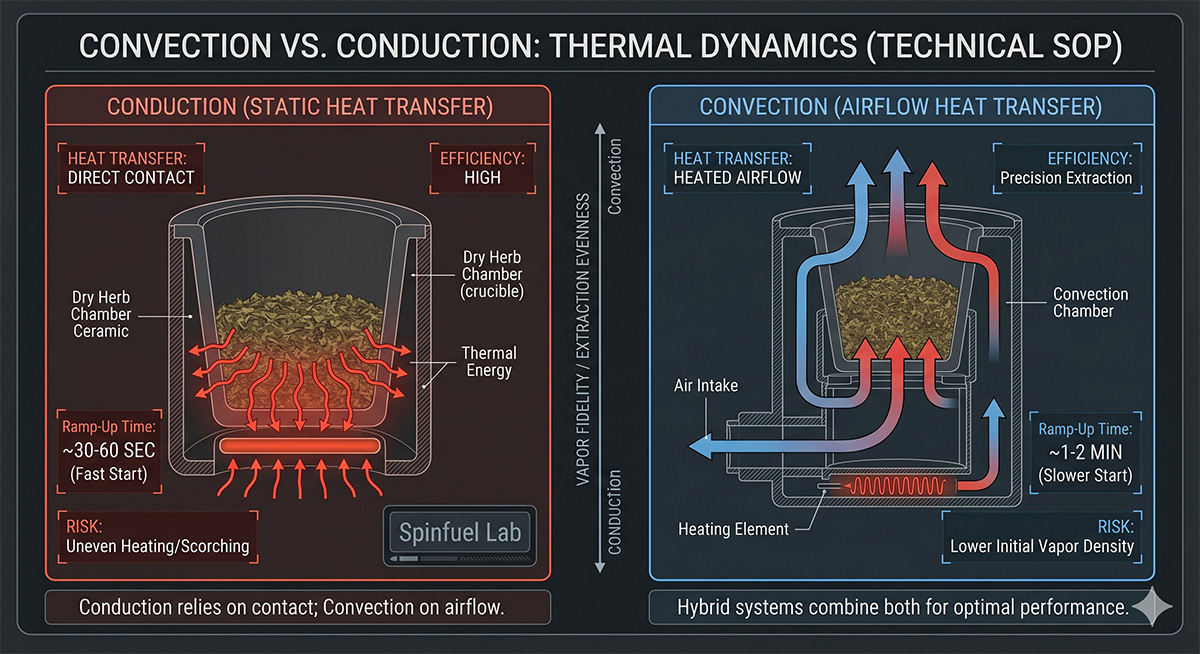
One principle of heat transfer. Two very different applications. This guide covers both — from the coil in your sub-ohm tank to the herb chamber of your dry herb vaporizer.
Why Heat Transfer Is the Only Thing That Actually Matters
Every vaping device ever made — from the simplest disposable to the most advanced regulated mod, from a cheap cig-a-like to a premium dry herb vaporizer — is, at its most fundamental level, a heat delivery machine. The battery, the chipset, the airflow design, the materials: all of it exists in service of a single task. Getting the right amount of heat to the right substance in the right way.
The physics governing how that heat gets delivered breaks down into two methods: conduction, which heats by direct contact, and convection, which heats by moving hot air. These are not vaping-industry terms. They are foundational concepts from thermodynamics that the vaping world has borrowed, applied, and — in the best modern hardware — begun to combine.
Understanding the difference between them explains almost everything. Why one device produces better flavor than another. Why one coil lasts longer. Why one herb vaporizer scorches the edges of your material while another processes it with surgical evenness. The engine determines the experience, every time.
A note on scope: Spinfuel has always been a nicotine and e-liquid publication, and that remains our core. But in 2026, the vaping landscape is broader than it was when we launched. Dry herb vaporizers have moved from fringe novelty to mainstream hardware, driven in no small part by the accelerating medical and legal acceptance of cannabis across dozens of US states and internationally. Patients managing chronic pain, anxiety, and a growing list of qualifying conditions are increasingly turning to dry herb vaporizers as a cleaner, more precise alternative to combustion. That hardware deserves honest, technically grounded coverage — and the physics of heat transfer is exactly where that conversation has to start. So this guide covers both worlds. The same principles. Two very different applications.
PART ONE: E-LIQUID VAPING
Heat Transfer in the Coil: What’s Actually Happening in Your Tank
The coil is the engine of every e-liquid vaping setup. Whether you’re running a sub-ohm tank, a rebuildable atomizer, or a salt-nic pod, something inside that device is getting hot, touching saturated cotton, and turning liquid into vapor. The question of how that heat is applied — and how evenly — determines everything you experience as a vaper.
Conduction in E-Liquid Vaping: The Direct Touch
Conduction heating in e-liquid vaping is exactly what it sounds like: the heated element makes direct physical contact with the substance being vaporized. In practical terms, this means the coil wire or mesh strip is pressed against — or in very close proximity to — the saturated cotton wick. When you fire the device, current runs through the resistive element, it heats up, and that heat transfers directly into the e-liquid held in the cotton fibers.
This is the dominant heating mechanism in the overwhelming majority of vaping hardware. Traditional round wire coils — Kanthal, SS316L, Ni80 — operate on conduction. So does mesh. The distinction between them is not about the heating method; both are conduction-based. The distinction is about how evenly that conductive heat is distributed across the contact surface, which is a topic The Lab has covered in depth in our mesh coil analysis.
The primary advantage of conduction in this context is immediacy. The heat path from resistive element to e-liquid is short, direct, and highly efficient. There is minimal thermal energy lost to the surrounding air. When you fire a well-saturated coil, vapor production begins within milliseconds. That fast, direct response is one of the reasons conduction-dominant designs remain the standard in high-performance sub-ohm tanks.
The tradeoff is the potential for uneven heating. Any conduction system is only as good as the uniformity of its contact surface. In traditional wound wire coils, the geometry of the coil itself creates variation — some sections of wire run hotter than others, producing the hot spots that have plagued coil design for years. Uneven heat means some portions of the e-liquid are being vaporized at a higher temperature than others. At best, this mutes complex flavor molecules. At worst, it scorches them.
Mesh architecture largely solved this for conduction-based e-liquid heating by replacing the cylindrical coil with a flat perforated strip that distributes heat across a wide, even contact surface. The physics of conduction didn’t change — but the geometry delivering it did, and the results speak for themselves in every blind flavor test ever run on mesh versus traditional coil hardware.
Convection in E-Liquid Vaping: Hot Air Enters the Picture
Pure convection in e-liquid vaping is rare, but it exists — and the airflow design of any tank or atomizer introduces convective heat transfer as a meaningful secondary mechanism even in coil-dominant setups.
True convection-based e-liquid atomizers heat the airstream before it contacts the liquid-saturated wick. The incoming air is warmed by proximity to a heating element, and that hot air is then pulled through or across the wick rather than having the element contact the wick directly. The result is a gentler, more uniform heat application — and in theory, more even vaporization with better preservation of the subtle flavor compounds that direct conductive heat can scorch.
In practice, the challenge with convection-dominant e-liquid designs is thermal efficiency. Because you’re heating air rather than a surface in direct contact with the medium, more energy is required to achieve the same vapor output. Ramp-up times are longer. The draw resistance characteristics are different. For e-liquid applications where vapor density and immediate response are primary goals, pure convection has never been able to fully compete with conduction.
Where convection does play a significant role in e-liquid vaping is in advanced airflow engineering. Modern high-performance tanks route incoming air across heated surfaces before it reaches the coil zone, pre-warming the airstream and creating a hybrid thermal environment around the wick. This reduces the thermal shock to e-liquid and contributes to the smoother, more complete vaporization that separates a well-engineered tank from a mediocre one. Most vapers experience the benefit of this without ever knowing it has a name.
Hybrid Heating in E-Liquid Hardware: The 2026 Standard
The most advanced e-liquid hardware available right now doesn’t make a choice between conduction and convection — it engineers both to work simultaneously. The coil or mesh strip provides direct conductive contact with the wick for immediate, efficient vaporization. The airflow path is engineered to pre-warm incoming air and distribute it evenly around the coil housing, introducing a convective thermal layer that moderates surface temperature spikes and promotes even vapor production across the full wick surface.
The practical result is a vaping experience that combines the best characteristics of both methods: the fast ramp-up and high vapor density of conduction, and the flavor fidelity and temperature uniformity that convective airflow engineering brings to the table. Premium sub-ohm tanks from the leading manufacturers are all playing in this space now. The single-method device is no longer the benchmark for serious hardware.
What this means for vapers is straightforward: if flavor accuracy matters to you — if you want the e-liquid you’re vaping to taste the way the flavor lab intended — the heating architecture of your hardware matters as much as the quality of the liquid itself. A poorly engineered conduction-only coil running hot spots through a premium e-liquid will still produce a compromised result. A well-engineered hybrid system will let the liquid perform.
PART TWO: DRY HERB VAPORIZERS
Heat Transfer in the Herb Chamber: A Different Set of Demands
Dry herb vaporizers operate on the same thermodynamic principles as e-liquid devices, but the substance being vaporized is fundamentally different — and those differences change everything about how heat transfer needs to be managed.
E-liquid is a homogeneous mixture. It flows. It saturates cotton evenly. It delivers itself to the heating element through capillary action. Ground plant material does neither of those things. It sits in a chamber, it clumps, it has air pockets and density variations, and it has a narrow optimal temperature range that separates clean vaporization from combustion. Manage the heat well, and you extract the active compounds cleanly and efficiently. Lose control of it, and you’re no longer vaporizing — you’re burning.
This is the context in which the conduction versus convection debate is most consequential. And it’s the context in which understanding the difference has real implications for the people using this hardware.
A Changed Landscape: Why Dry Herb Hardware Belongs in This Conversation
Spinfuel’s expansion into dry herb vaporizer coverage isn’t a pivot away from our core audience. It’s a recognition that the vaping landscape in 2026 looks meaningfully different from what it did five years ago.
As of 2026, medical cannabis is legal in the majority of US states, with full adult-use legalization now in place across a substantial and growing portion of the country. Internationally, Germany, Australia, and a widening list of nations have formalized medical cannabis frameworks that put herb vaporizers in pharmacies and on prescription pads. The patient population using these devices is not a fringe demographic — it includes people managing chronic pain, multiple sclerosis, PTSD, chemotherapy-related nausea, and a range of other conditions for which cannabis has demonstrated therapeutic value in clinical research.
For those patients, the difference between a conduction vaporizer and a convection vaporizer is not an enthusiast preference. It’s a question of whether their medicine is being extracted efficiently and cleanly, at temperatures that preserve the therapeutic compounds they need, without the combustion byproducts that defeat the purpose of vaporizing in the first place. That’s a conversation worth having carefully, and having right.
Conduction in Dry Herb Vaporizers: Speed vs. Precision
In a conduction dry herb vaporizer, the herb is loaded into a chamber — typically ceramic or stainless steel — that is in direct contact with the heating element. When the device reaches operating temperature, heat transfers from the chamber walls directly into the plant material through physical contact.
The principal advantage of conduction in this application is the same as it is in e-liquid hardware: speed. Conduction devices reach operating temperature quickly, and the first draw can be taken within thirty to sixty seconds of activation on most modern units. For patients or users who need rapid onset without lengthy warmup rituals, this matters.
The disadvantage is uneven heating. The plant material touching the chamber walls receives more heat than the material in the center of the load. This produces the dry herb equivalent of hot spots — the outer layer of the herb processes first, while the inner portion lags behind. The practical consequence is that users need to stir the chamber between draws to expose unprocessed material to the heated walls. Skip that step, and the outer material risks overheating and approaching combustion temperatures while the center of the load is still barely warm.
Modern conduction devices have addressed this partially through chamber geometry — shallower loads, better thermal mass distribution, precision temperature controls — but the fundamental limitation is inherent to the method. Direct contact heating and irregular solid material are not a natural pairing. The results are good on well-designed hardware; they are rarely perfect.
Convection in Dry Herb Vaporizers: The Purist’s Choice
Convection dry herb vaporizers take a fundamentally different approach. Rather than heating the chamber walls and relying on contact to warm the herb, a convection device heats the incoming air before it enters the herb chamber. The hot air is then drawn through the material by the user’s inhale, vaporizing the active compounds as it passes through.
The result is a transformation in how evenly the herb is processed. Because every particle of plant material is exposed to the same heated airstream, vaporization is consistent from the outside to the center of the load. There are no hot spots. There is no differential between the edges and the middle. The herb processes as a unified mass, which means the full active compound profile is available in every draw rather than in a gradient from the outside in.
For patients using cannabis medicinally, this is particularly relevant. Different therapeutic compounds in cannabis — cannabinoids and terpenes — vaporize at different temperatures. A convection device, running at a precise and even temperature, extracts these compounds with a fidelity that conduction devices struggle to match. The flavor profile is cleaner, the extraction is more complete, and there is essentially zero risk of combustion as long as the device is set within an appropriate temperature range, because the herb never touches a superheated surface directly.
The tradeoff is time and draw technique. Convection vaporizers take longer to reach operating temperature than conduction units. They also typically require a longer, slower draw to pull sufficient hot air through the chamber — a learned technique that some users find less intuitive than the short, sharp hits that conduction devices reward. For medical patients, particularly those newer to vaporizer hardware, this learning curve is worth acknowledging.
Hybrid Technology in Dry Herb Vaporizers: Both Engines, One Device
The premium end of the dry herb vaporizer market in 2026 is dominated by hybrid designs that combine conduction and convection heating within a single device. The herb chamber is heated conductively from the walls — providing the fast startup and immediate draw response that conduction enables — while the airflow path is engineered to deliver a pre-heated convective airstream through the material simultaneously.
The effect is a device that starts quickly like a conduction vaporizer and processes the herb evenly like a convection unit. The hybrid approach essentially uses conduction to handle the thermal inertia problem — getting the whole system up to temperature fast — and convection to handle the uniformity problem, ensuring the herb processes evenly once temperature is achieved.
For the medical patient, this is the most practically useful category of device available today. The on-demand speed means medication can be accessed without lengthy preparation windows. The convective evenness means the full therapeutic compound profile is extracted consistently. And the precision temperature controls that accompany premium hybrid hardware allow users to target specific temperature ranges for specific compound profiles — something that is not meaningfully achievable on a basic conduction device with imprecise thermal management.
The price premium for hybrid devices is real and worth acknowledging — quality hybrid vaporizers occupy the upper tier of the market. But for users who rely on this hardware medically, the efficiency gains in extraction quality mean that the cost per session is frequently lower than it appears, because more of the material is being fully processed rather than unevenly spent.
The Lab’s Verdict: Same Physics, Two Different Disciplines
Pull back from both applications and the underlying story is consistent. Conduction delivers heat quickly and directly, with efficiency as its defining strength and uneven distribution as its defining weakness. Convection delivers heat evenly and gently, with flavor fidelity and uniformity as its strengths and slower response as its limitation. Hybrid architecture, at its best, resolves the tension between the two.
In e-liquid vaping, the battle was largely settled by mesh coil technology, which transformed conduction heating from a hot spot-prone compromise into a genuinely high-performance system — and then by advanced airflow engineering that introduced convective elements to further refine the experience. The best hardware you can buy for e-liquid vaping today is a hybrid system, whether or not it’s marketed as one.
In dry herb vaping, the same evolution is playing out with more visible stakes. The difference between a poorly designed conduction device and a well-engineered convection or hybrid unit is the difference between partially processed material, inconsistent draws, and combustion risk on one hand — and clean, full-spectrum extraction at precise temperatures on the other. For recreational users, that difference is about preference. For medical patients, it’s about whether the device is actually doing its job.
Spinfuel will be covering dry herb vaporizer hardware in depth going forward — device reviews, temperature guides, and category comparisons. We approach it the same way we approach everything else in these pages: honest, technically grounded, and with no interest in telling you something is good when it isn’t. The physics don’t lie, and neither do we.
Understand how your device heats. Everything else follows from there.
— Spinfuel.com | The Lab
Sterling Grey
Founder & Lead Researcher, Spinfuel Lab
With over 15 years in the industry, Sterling leads the Spinfuel Lab’s technical evaluation and engineering analysis divisions.