
Forensic Analysis: The Science
& Limitations of Hair Testing
Chemical Analysis • 2026 Forensic SOP
Hair follicle testing occupies an odd corner of forensic toxicology. It is invasive in a way urine testing is not — you are handing over a physical piece of yourself that carries a ninety-day chemical record — but it is also uniquely resistant to the last-minute dilution tricks that undermine other screening methods. That combination has made it a favorite of private employers, family courts, treatment programs, and legal proceedings, while leaving it conspicuously absent from federal workplace programs where you might expect it to dominate.
The science behind how it works is legitimately impressive. The limitations and controversies behind why it has not replaced urinalysis are just as real. Here is the current state of hair follicle testing in 2026, stripped of the marketing language you will find on lab websites.
How Hair Records Drug Use
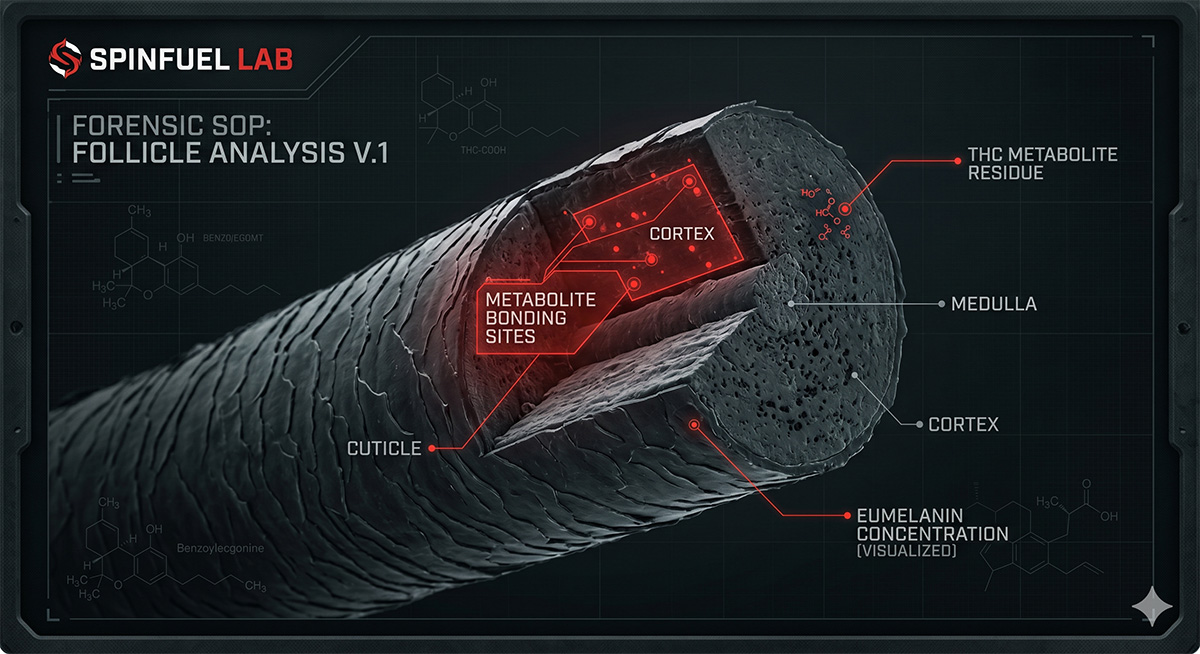
Your hair is a biological archive. Each strand grows out of a small bulb at the base of a follicle, anchored in living tissue that shares its blood supply with the rest of your body. When a drug enters your system, its metabolites circulate in your bloodstream and pass through the capillary network feeding those follicles. Some fraction of those molecules diffuses into the growing hair shaft, where they become locked into the keratin matrix as the hair hardens and pushes out of the scalp.
Three pathways deliver drug compounds into hair. The first is direct diffusion from blood capillaries into the active growth zone. The second is deposition from sweat and sebum, which continuously bathe the hair shaft as it emerges. The third is external environmental exposure — smoke in the air, residue on fingers, contaminated surfaces. The first two are what the test is designed to measure. The third is what makes hair testing scientifically and legally controversial.
Scalp hair grows at roughly half an inch per month, give or take depending on the individual. A standard 1.5-inch sample cut close to the scalp therefore represents about ninety days of recent history, which is the window most commercial panels advertise. Body hair grows more slowly and has a longer resting phase, which can extend the potential detection window to a year or more — but it also destroys any meaningful ability to pinpoint when use actually occurred.
The Lab Process, Step by Step
A hair follicle test is not one test. It is a sequence of procedures that screens a sample broadly, then confirms any positive hits with a second, much more specific method. Here is the full chain.
1. Collection
A trained collector takes approximately 100 to 120 strands from the crown of the head, cut as close to the scalp as possible. The sample is usually about the thickness of a shoelace tip. It gets sealed in foil or a specimen envelope with chain-of-custody documentation — who took the sample, when, from where, and who handles it next. Chain of custody is what makes the result admissible in court.
2. Wash Protocol
Before anything else, the lab washes the sample to remove external contamination. Protocols vary by lab but typically involve an organic solvent like methanol or isopropanol, sometimes followed by aqueous buffer rinses. The wash fluid is often analyzed separately to assess whether external exposure may have been significant. This step is the primary defense against environmental contamination claims, and it is also one of the most scientifically contested parts of the process.
3. Digestion
The washed hair is broken down so that embedded compounds can be extracted. This is done either by dissolving the keratin matrix in a strong base, or by enzymatic digestion with proteinase enzymes, or by pulverizing the hair and extracting with solvent. Different targets require different approaches.
4. Screening (Immunoassay)
The digested extract goes through an enzyme immunoassay (ELISA or EIA), which uses antibodies engineered to recognize broad drug classes. This is a fast, inexpensive screen. It flags samples for further analysis but cannot identify specific compounds or distinguish between closely related molecules.
5. Confirmation (GC-MS or LC-MS/MS)
Any sample flagged in screening moves to mass spectrometry, typically gas chromatography-mass spectrometry or liquid chromatography with tandem mass spectrometry. These methods separate compounds, identify them by their unique mass-to-charge fingerprint, and quantify them to the picogram-per-milligram level. A GC-MS or LC-MS/MS confirmation with proper controls has a vanishingly small false-positive rate when performed correctly.
6. Cutoff Comparison and Reporting
The quantified result is compared against an established cutoff. Below the cutoff, the sample is reported negative. Above, it is reported positive for that specific compound. Cutoffs are set low enough to detect regular use but high enough to minimize false positives from trace environmental exposure.
What the Standard Panel Detects
The industry-standard hair panel mirrors the SAMHSA-5 used in urine testing, with expanded options available for specific purposes. The test does not look for parent drugs alone — it looks for specific metabolites that can only be produced by the body processing those drugs.
- Marijuana: 11-nor-9-carboxy-THC (THC-COOH), a metabolite produced only through metabolism. This distinction matters — the test is built to exclude passive smoke exposure.
- Cocaine: Cocaine itself plus benzoylecgonine, norcocaine, and cocaethylene (produced when cocaine is used with alcohol)
- Opiates: Codeine, morphine, 6-monoacetylmorphine (6-MAM, which is specific to heroin), hydrocodone, oxycodone
- Amphetamines: Amphetamine, methamphetamine, MDMA, MDA
- Phencyclidine (PCP)
Extended panels add benzodiazepines, barbiturates, fentanyl and fentanyl analogues, synthetic opioids, ketamine, and in some cases nicotine metabolites like cotinine. Life insurance companies and a handful of employers screen separately for cotinine to verify nonsmoker status.
Federal workplace drug testing follows its own guidelines under the oversight of SAMHSA’s Division of Workplace Programs, which maintains technical specifications, cutoffs, and certified laboratory requirements for the federal programs it covers.
The Accuracy Question
Hair testing has real analytical strengths. You cannot dilute hair by drinking water. You cannot substitute someone else’s sample without the collector watching you cut it. The detection window is long enough to catch patterns that a 48-to-72-hour urine window would miss entirely. And mass spectrometry confirmation, done correctly, identifies specific molecules with a precision urine immunoassay cannot match.
Those strengths are the reason child custody courts and certain safety-sensitive private employers lean on hair testing. When the question is whether someone has used a substance regularly over a period of months — not whether they used it last weekend — hair delivers a kind of answer other methods cannot.
But the same biology that makes hair testing powerful also introduces vulnerabilities that urine testing does not share. That is where the controversy starts.
Known Limitations and Controversies
Hair Color Bias
This is the single most important limitation, and it is the main reason hair testing has never been certified for federal workplace programs. Peer-reviewed research going back more than two decades has shown that darker hair binds certain drug classes more readily than lighter hair. Melanin — specifically eumelanin, the pigment concentrated in dark hair — acts as a binding site for basic drugs like cocaine, methamphetamine, amphetamines, and nicotine. The Society of Hair Testing has published extensively on this issue and continues to refine guidance around interpretation.
The practical implication is uncomfortable. Two people using identical amounts of the same substance can show substantially different hair concentrations based on nothing but the pigment profile of their hair. Because hair color distribution is not racially neutral, this has civil-rights implications that have dogged the technology for years. THC is less affected because it is a neutral compound with weaker melanin affinity, but the bias is well-documented for the stimulants and opioids that dominate most panels.
Environmental Contamination
Smoke in a room. Drug residue on a surface someone then touched their hair with. Cocaine or methamphetamine particulates circulating in an indoor environment. All of these can deposit compounds onto the external hair shaft. Wash protocols are designed to remove this external material, and metabolite-based cutoffs (like requiring THC-COOH rather than just THC) help distinguish metabolic incorporation from surface contamination. But the wash protocols are not uniform across labs, and critics have published data suggesting heavy external exposure can survive standard washing.
Cosmetic Hair Treatments
Bleaching, permanent dyes, relaxers, and perms chemically damage the hair shaft and can reduce detected drug concentrations significantly — often 40 to 80 percent depending on the treatment and the compound. They rarely bring levels to zero, but they can push moderate users below the cutoff. This creates another bias vector, since people who chemically treat their hair more frequently may show systematically lower readings regardless of actual use.
Detox Products
The market is flooded with detox shampoos, cleansing rinses, and home protocols that promise to defeat hair testing. Independent research — including work funded by the testing industry itself — has consistently shown that most of these products have modest to negligible impact on confirmed laboratory results. Some can interfere with immunoassay screening, but they generally do not survive GC-MS or LC-MS/MS confirmation. This is one of the few areas where the testing industry and independent researchers broadly agree.
Sample Limitations
People with short hair, shaved heads, or medical conditions affecting hair growth create collection problems. Body hair can be used as an alternative, but the longer growth cycle and resting phase eliminate the ability to establish a timeline. A positive body hair result confirms use within the past year or so, but it cannot tell you whether that use was last month or last April.
Where Hair Testing Stands Legally
The legal landscape in 2026 remains fragmented. SAMHSA proposed scientific and technical guidelines for federal workplace hair testing years ago, but final certification has been repeatedly delayed over the color bias and contamination issues described above. Federal workplace programs under HHS authority and DOT-regulated transportation testing continue to require urine, with oral fluid approved more recently as an alternative.
Private sector use is another story entirely. Private employers not bound by federal testing rules use hair testing freely, particularly in industries that value the long detection window. Family courts use it routinely in custody disputes where a history of use rather than a recent use is the question. Addiction treatment programs use it to verify sustained abstinence. Law enforcement and forensic investigators use it in post-mortem toxicology and historical reconstruction.
Internationally, several European jurisdictions accept hair toxicology as standard court evidence. The United Kingdom’s family courts have used it for decades. Interpretation standards differ country to country, which matters if you are working across jurisdictions.
What This Means for Cannabis Users and Vapers
For cannabis specifically, a few points worth knowing. The test looks for THC-COOH, the carboxy metabolite that can only be produced by your liver processing THC — not parent THC itself. This means passive secondhand smoke exposure, even significant exposure, generally does not produce a confirmed positive, because you cannot metabolize what you did not consume.
The method of cannabis consumption does not meaningfully change what shows up in hair. Smoking, vaping flower, dabbing concentrates, dosing edibles — all produce THC-COOH through the same metabolic pathway. The amount and frequency of use influence hair concentrations far more than the delivery method.
Light or occasional cannabis users sometimes fall below the THC-COOH hair cutoff, which is set low but not zero. Heavy or regular users — the threshold that matters for most custody and employment contexts — are reliably detected within the ninety-day window.
Nicotine is a separate question. Standard hair drug panels do not include it. Cotinine hair testing exists and is used by some life insurance underwriters and a small number of employers, but it is not part of the SAMHSA-5 or most extended panels. For broader context on how drug use research is studied and reported, the National Institute on Drug Abuse publishes ongoing research summaries covering pharmacology, detection, and treatment.
The Bottom Line
Hair follicle testing delivers something no other method can match: a reliable ninety-day chemical record that is difficult to dilute, substitute, or fake in the moment. For the contexts where that long window matters — custody disputes, treatment verification, historical forensic questions — it is the right tool.
But the color bias problem is real, the environmental contamination debate is not settled, and the cosmetic treatment effect creates another layer of variability. These are not fringe concerns raised by defense attorneys looking for an angle. They are the specific reasons federal workplace programs have declined to certify the method despite years of pressure to do so.
Hair testing is not going anywhere. It is too useful, too entrenched, and too profitable for the labs that run it. But it is also not going to replace urinalysis for federal and regulated workplace programs anytime soon. Understanding both sides of that equation — the genuine analytical precision and the equally genuine limitations — is the only honest way to read a hair test result.
