How to Fix a Clogged Vape Pen: A Troubleshooting Guide

How to Fix a Clogged Vape Pen: A Comprehensive Troubleshooting Guide.

 How to Fix a Clogged Vape Pen

“A clog is not a hardware failure; it is a thermal challenge. Restoring airflow requires understanding the relationship between liquid viscosity and heat.”

Vape pens have revolutionized the portability of nicotine and botanical extracts, but encountering a clog can bring your experience to a standstill. Airflow obstruction is one of the primary causes of user dissatisfaction across every category of vaping hardware — from entry-level cartridge pens to sophisticated rebuildable setups. The good news is that the vast majority of clogs are fixable in under five minutes once you understand what you’re actually dealing with.

This guide covers the complete Spinfuel troubleshooting protocol: the three types of clog, the standard restoration procedure, device-specific considerations, prevention strategies, and the diagnostic indicators that tell you when a clog has crossed into actual hardware failure territory.

INTERNAL LINK NOTE: Anchor point: Link to Spinfuel’s vape pen hardware overview and variable wattage settings guide when published.

I. Understanding What a Clog Actually Is

The word “clog” gets applied to three distinct problems in vaping hardware, each with different causes and different solutions. Treating them as the same issue is why many users apply the wrong fix and make the situation worse. Before you reach for a tool or fire the device, identifying which type you’re dealing with takes thirty seconds and saves significant frustration.

Type 1: Condensation Buildup

This is the most common clog and the easiest to fix. As vapor travels through the airpath from the coil to the mouthpiece, it cools and a portion condenses back into liquid. Over time — particularly with high-VG e-liquids and in cooler ambient temperatures — this condensate accumulates on the inner walls of the chimney and airpath, progressively narrowing the channel until airflow becomes restricted or cuts off entirely.

Condensation clogs feel gradual. The draw gets progressively tighter over multiple sessions rather than failing suddenly. The liquid you clear from this type of clog will be thin and relatively clear — it is condensed vapor, not e-liquid that has flooded the coil. This distinction matters because the fix is thermal, not mechanical.

Type 2: Flooded Coil

A flooded coil happens when e-liquid saturates the coil beyond its capacity to vaporize it. This can result from over-priming a new coil, using a device at wattages too low to fully vaporize the liquid being delivered, or leaving a device sitting unused for extended periods while liquid continues to wick into the coil.

A flooded coil announces itself differently from condensation buildup. You will typically hear a gurgling or bubbling sound when you draw. The hit may feel wet or produce liquid in your mouth. In severe cases the device may not fire cleanly at all. The fix involves clearing the excess liquid from the coil zone before resuming normal use.

Type 3: Hardened Residue

The most stubborn clog type. High-viscosity liquids — particularly thick distillates in cartridge pens, high-sugar content e-liquids, and certain botanical concentrates — can cool and harden inside the chimney, center post, or airpath into a semi-solid or solid obstruction. Unlike the first two types, hardened residue does not yield to suction alone. It requires thermal softening followed by mechanical clearance.

Hardened residue clogs tend to occur after periods of inactivity, particularly if the device was stored in a cool environment. The obstruction feels absolute — minimal or zero airflow even with a sharp, forceful draw. Identifying this type correctly is important because attempting to fire the device with a hard obstruction can burn the coil before the liquid has a chance to flow.

INTERNAL LINK NOTE: Anchor point: Link to Spinfuel’s e-liquid viscosity guide (VG/PG ratios) and coil priming guide when published.

II. Standard Operating Procedure: The Spinfuel Restoration Protocol

The following four-step protocol addresses all three clog types in the correct order. Work through the steps sequentially — do not skip to mechanical clearance before attempting thermal restoration, as unnecessary mechanical intervention risks damaging seals and center posts that were not actually obstructed.

Step 1 — Thermal Reduction: Warm the Cartridge

Warm the cartridge or tank between your palms for thirty to sixty seconds. The objective is to raise the temperature of the e-liquid or concentrate just enough to reduce its viscosity — to thin it from its cooled, thickened state back toward its working consistency. This single step resolves the majority of condensation buildup clogs and all hardened residue clogs that are in their early stages.

Do not use external heat sources — lighters, hair dryers, or hot water. The temperature differential risk to seals, cartridge housing, and coil components is not worth it when palm warmth is sufficient. For stubborn hardened residue, extend the warming time to two to three minutes rather than increasing the heat source.

Step 2 — The Inert Pull: Airpath Vacuum

Without activating the battery, inhale sharply through the mouthpiece. The vacuum created by a forceful draw without firing can pop a condensation seal or dislodge softened residue from the chimney walls. Repeat two to three times. This step is particularly effective on condensation clogs where the buildup has formed a meniscus — a surface tension seal — across the airpath.

If the device has a draw-activated firing mechanism rather than a manual button, cover the airflow intake with a finger while drawing to prevent accidental activation. You want airpath suction without heat.

Step 3 — Mechanical Clearance: The Center Chimney

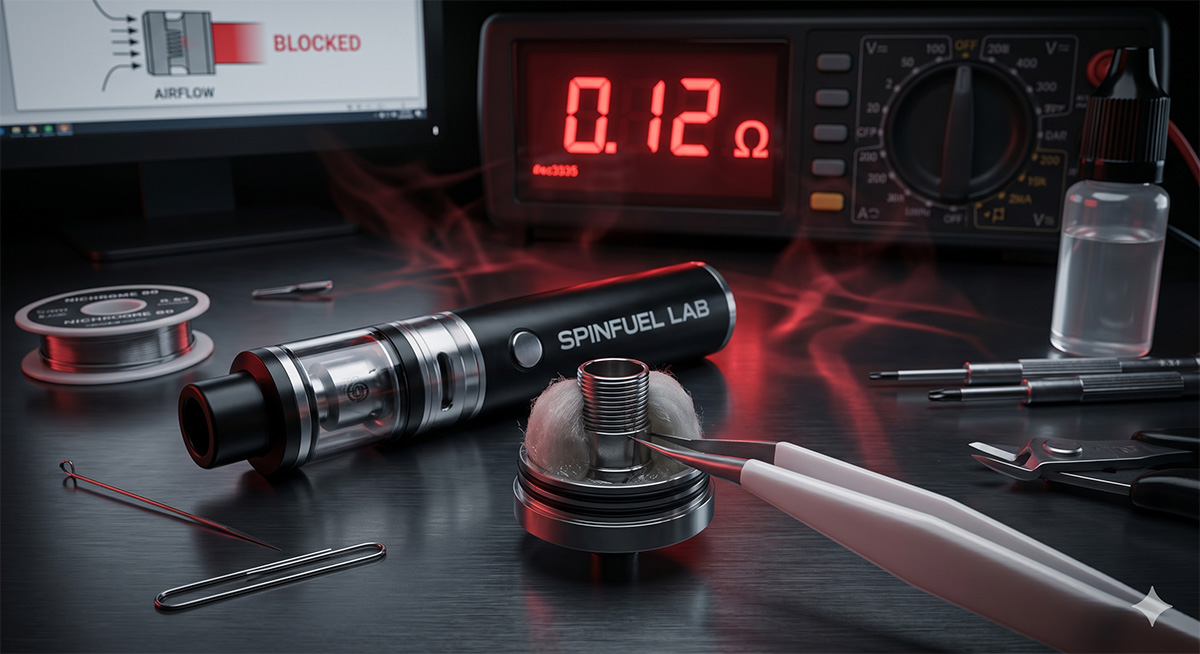
If the first two steps have not fully restored airflow, use a micro-tool — a thin wire, a toothpick, or a dedicated vape cleaning tool — to clear the center chimney of pooled residue. Insert the tool gently into the mouthpiece opening and work it in a light circular motion along the chimney walls. The goal is to break up and clear condensed or hardened material, not to scrape aggressively.

For cartridge pens with a fixed mouthpiece, the access point is the mouthpiece aperture itself. For refillable tanks and pods, removing the mouthpiece or top cap first gives better access. Wipe the tool clean between passes and check the airpath by doing an inert pull after each pass rather than continuing to probe blind.

If the material you are clearing is dark, thick, or acrid-smelling, this indicates burnt residue from a previously dry-fired coil rather than condensate or e-liquid. Note this for the diagnostic section at the end of this guide — it changes the prognosis for the coil.

Step 4 — Power Calibration: Wattage and Airflow Optimization

Once airflow is restored, review your power settings before resuming normal use. A clog that recurs rapidly after clearing is almost always a symptom of operating at a wattage that is mismatched to the liquid’s viscosity. High-VG and high-viscosity liquids require more power to vaporize cleanly — running them at low wattages means incomplete vaporization, which produces excess condensate and accelerates chimney buildup.

Increase wattage in small increments — two to three watts at a time — until the draw produces clean, fully vaporized aerosol without the gurgling that indicates liquid is being carried through rather than vaporized. Consult the coil manufacturer’s recommended wattage range, which is typically printed on the coil head, and stay within the upper half of that range for high-viscosity liquids.

INTERNAL LINK NOTE: Anchor point: Link to Spinfuel’s wattage and coil resistance guide when published.

III. Device-Specific Considerations

The restoration protocol above applies universally, but clog behavior differs meaningfully between hardware categories. Understanding where your specific device type is most vulnerable helps you both fix and prevent problems more effectively.

Cartridge Pens and Pre-Filled Pods

Cartridge pens — particularly those using thick distillate or oil-based concentrates — are the most clog-prone category. The high viscosity of the liquid combined with the small diameter of the center post aperture in most 510-thread cartridges creates ideal conditions for hardened residue clogs at any temperature below room temperature. Storing cartridge pens upright when not in use reduces the rate at which liquid migrates into the center post. Storing them in a warm pocket rather than a cold bag during outdoor use in cold weather prevents the viscosity issue that causes most of the hardware-environment clogs in this category.

Pre-filled pod systems are generally less susceptible to clogs than cartridge pens because the coil and pod geometry is optimized for the specific liquid formulation being used. When they do clog, it is almost always a condensation buildup issue in the mouthpiece rather than a coil-level obstruction — and it clears easily with an inert pull or a quick wipe of the mouthpiece channel with a cotton swab.

Refillable Pod Systems

Refillable pods add a variable the factory-filled category does not have: the user chooses the liquid. Pairing a high-VG liquid with a pod coil rated for higher-PG formulas is a very common source of recurring clogs. High-VG liquid is too thick to wick efficiently through the cotton in a coil designed for thinner liquid — it cannot saturate fast enough to keep pace with vaporization, and the sections of cotton that do get saturated over-deliver liquid to the coil zone, causing flooding and gurgling.

If your refillable pod system clogs repeatedly with the same liquid, the fix is usually a liquid swap rather than a hardware intervention. Move to a 50/50 or 60VG/40PG formulation and the problem typically resolves without any hardware modification.

Sub-Ohm Tanks

Sub-ohm tanks running mesh or traditional coil heads at high wattages are the least likely category to develop clogs during normal use — the high operating temperature means condensation rarely gets a chance to accumulate. When they do clog, it is almost always a flooding event caused by over-priming, a wicking failure in a rebuildable deck, or a liquid that is too thin for the coil’s delivery rate at the wattage being used.

A flooded sub-ohm tank will gurgle loudly on the draw and may spit liquid into the mouthpiece. The fix is to remove the tank, fire the device briefly without the tank to clear the mod’s 510 pin area of liquid, then hold the tank mouthpiece-down over a paper towel and give the base a few sharp flicks to expel the flooded liquid from the coil zone before reassembling.

INTERNAL LINK NOTE: Anchor point: Link to Spinfuel’s sub-ohm tank guide, coil priming guide, and mesh coil evolution article when published.

IV. Preventing Secondary Blockages

A clog that comes back within a few sessions of clearing is telling you something about the relationship between your liquid, your hardware, and your usage pattern. The original article correctly identifies over-wicking as the most common failure point in rebuildable setups — but it is one of several prevention principles worth understanding in full.

Wicking Technique in Rebuildable Setups

In a rebuildable atomizer, the cotton wick performs two jobs simultaneously: it delivers liquid to the coil and it acts as a valve that controls how quickly that liquid arrives. Cotton that is packed too densely into the wicking ports chokes both functions. Liquid delivery slows to the point where the coil runs dry on heavy draws, and the restricted airflow through the wicking ports causes vapor to condense and accumulate in the chimney rather than exit cleanly through the mouthpiece.

The correct wicking density allows the cotton to slide through the coil with light resistance — not freely, not tightly. The wick tails should fill the wicking ports without being compressed into them. If you have to force the cotton or use a tool to tuck the tails, you have over-wicked. Trim the tails and re-wick. The few minutes this takes prevents the hardened chimney clog that takes considerably longer to clear.

Liquid Storage and Temperature Management

E-liquid and concentrate viscosity increases significantly as temperature drops. Devices left in a car overnight in winter, stored in a cold room, or carried in an outer jacket pocket in cold weather will develop viscosity-related clogs that would never occur at room temperature. The fix is behavioral: bring the device to room temperature before use and store it in a location where temperature stays consistent.

High-sugar e-liquids — particularly bakery and candy profiles with high sweetener content — caramelize on coil surfaces faster than other formulas. The residue this produces is stickier, darker, and harder than standard coil gunk, and it accumulates in the chimney at a faster rate. If these are your preferred flavors, plan for more frequent coil changes and chimney clearance than you would with tobacco or fruit profiles.

Airflow and Draw Technique

Slow, long draws at low wattages are the usage pattern most likely to produce condensation buildup. The aerosol has more time to cool in the airpath before it exits the mouthpiece, and the lower temperature means more of it condenses rather than staying as vapor. If you prefer a slow, restricted draw style — which many MTL vapers do — compensate by using higher-PG liquids that produce less condensate by volume, and clear the mouthpiece with an inert pull at the end of each session rather than waiting for a full blockage to develop.

Regular Maintenance Intervals

A clog that requires emergency clearance is always a maintenance interval that was missed. The steps that prevent clogs are short: wipe the mouthpiece channel with a cotton swab at the end of each session, inspect the chimney for condensate every week, and replace coil heads before the end of their rated life rather than after. Degraded cotton wicks faster than fresh cotton, which accelerates flooding. Coils with heavy residue buildup on the wire or mesh surface run hotter in some spots than others — recreating the hot spot problem that uneven heating produces, and increasing the rate of chimney condensation.

INTERNAL LINK NOTE: Anchor point: Link to Spinfuel’s coil maintenance and replacement guide when published.

V. When to Stop: Distinguishing a Clog from Hardware Failure

Not every airflow problem is a clog, and continuing to attempt clearing procedures on a device with an underlying hardware fault can cause damage or create a safety risk. The following diagnostic indicators are the signal to stop troubleshooting and evaluate whether the hardware needs replacement rather than clearance.

The Burnt Hit That Doesn’t Resolve

A single burnt hit after a dry fire is a coil that ran without sufficient liquid — uncomfortable, but recoverable if you saturate the wick and allow time for it to re-prime before firing again. A burnt taste that persists after re-priming and continues across multiple sessions indicates a coil where the cotton has been carbonized beyond recovery. No amount of clearing will fix this because the problem is not an obstruction — it is a destroyed wicking medium. Replace the coil.

Zero Airflow After Full Protocol

If you have worked through all four restoration steps and airflow has not improved at all, one of three things is true: the clog is a hardened residue deposit that has fully solidified and is beyond thermal softening, the center post has been mechanically damaged and is physically collapsed, or the internal airpath has a manufacturing defect or seal failure. Cartridge pens with zero airflow after full protocol are typically past recovery — the internal geometry of most sealed cartridges does not allow for deeper mechanical intervention without destroying the housing.

Liquid in the Mod or Battery Section

If liquid has migrated down through the 510 connection into the mod body or battery compartment, stop using the device immediately. Liquid in the mod body is not a clog — it is a flooding event that has progressed to a point where it poses a short-circuit risk to the battery. Disassemble, dry thoroughly, and inspect the mod’s 510 pin and interior before resuming use. If liquid has reached the battery cells in an integrated device, do not attempt to use it and do not charge it.

Unusual Sounds, Smells, or Heat

A device that makes crackling sounds beyond the normal, mild crackle of vaporization, produces a chemical or burning smell that is not attributable to e-liquid flavor, or becomes unusually warm to the touch in the battery or mod section during use should be set aside immediately. These are not clog symptoms. They are indicators of a coil short, a battery issue, or a component failure that requires hardware inspection before the device is used again.

INTERNAL LINK NOTE: Anchor point: Link to Spinfuel’s battery safety guide and mod hardware troubleshooting guide when published.

The Lab’s Diagnostic Summary

The table below maps the most common symptom presentations to their probable cause and first-line fix. Use it as a quick-reference diagnostic before working through the full protocol.

Gradual draw restriction over several sessions: Condensation buildup. Start with thermal reduction and inert pull.

Gurgling sound, wet hit, or liquid in mouthpiece: Flooded coil. Expel excess liquid with sharp flicks before firing.

Sudden complete airflow loss, especially after cold storage: Hardened residue. Extended palm warming followed by mechanical clearance.

Recurring clog despite clearing: Liquid/hardware mismatch. Review wattage settings and PG/VG ratio for your coil type.

Burnt taste persisting after re-prime: Coil end-of-life. Replace the coil head before further use.

Zero airflow after full protocol: Possible center post collapse or sealed obstruction. Evaluate hardware replacement.

The majority of clogs resolve at Step 1 or Step 2. Reaching Step 4 without resolution is a signal to reassess whether you are dealing with a clog at all. When in doubt, the safest course is always to replace the coil and re-prime rather than continue working on hardware that may have moved past the clog category into failure territory.

Airflow restored is a thermal problem solved. Airflow that cannot be restored is a hardware conversation.

INTERNAL LINK NOTE: Anchor point: Link to Spinfuel’s full Knowledge Base hardware index when published.

— Spinfuel.com | Hardware Lab  |  Knowledge Base

Published by Spinfuel Lab Research Division  •  NH – USA

Stay in the Loop

Get the latest reviews, news, and guides delivered straight to your inbox.